
What Is Augmented Reality? A Beginner’s Guide to Augmented Reality
Have you ever used a filter on your phone that makes your face look like it has dog ears? Or maybe you utilised an app to make it look like you had a fake couch in your living room before you bought it?
When real things and digital things operate together, that’s called augmented reality (AR). And to be honest, you probably didn’t know it had such a fancy name until now.
This book will teach you all you need to know about augmented reality, like what it is, how it works, where you can see it every day, and where it is heading. Just a lovely chat, no tech discussion.
What Is Augmented Reality?
Augmented reality is a kind of technology that adds digital noises, pictures, or information to the real world. You can usually see it on your iPad, phone, or special AR glasses.
The technology makes your real kitchen, street, or face look better, but you can still see them.
AR doesn’t take the place of reality; it makes it better.
That’s the fundamental factor that sets AR apart from places that aren’t real at all. You are still in the real world; AR only makes it more fascinating, useful, or enjoyable.
How Does Augmented Reality Work?
You might be curious in how a filter knows where your nose is or how your phone knows where to put a virtual lamp in your living room.
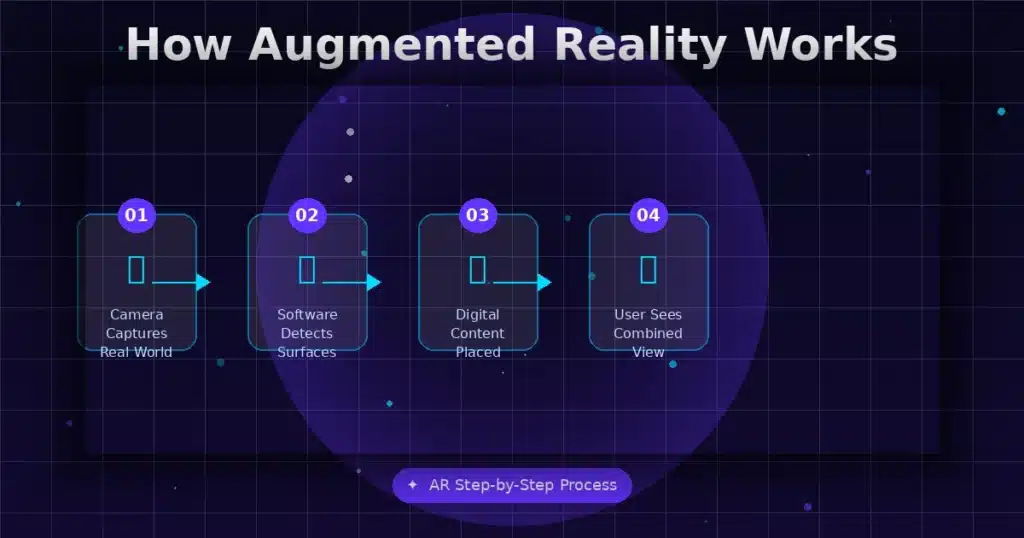
This is how it works, step by step:
Step 1: The camera takes pictures of things that are real. The camera on your phone or AR device records or takes pictures of what you see right now.
Step 2: The software looks at what it sees. Smart algorithms seek for faces, surfaces, objects, or certain markers in the picture. This is how a computer views things.
Step 3: Putting the digital parts where they belong. The program finds the optimal place for a 3D object, effect, or overlay such that it seems like it belongs there.
Step 4: You see the view that has been pieced together. There are no gaps between the digital stuff on your screen or AR glasses and the real world.
Every day, the IKEA AR app shows you how this works in real life. You can choose a couch from their catalogue and then use your phone to position it at your room. Then, the application makes a 3D picture of the couch that is the same size as the couch and sets it in your room. You can walk around it, check how big it is, and see if the colour works, all for free.
That’s what augmented reality is.
Augmented Reality Examples in Daily Life
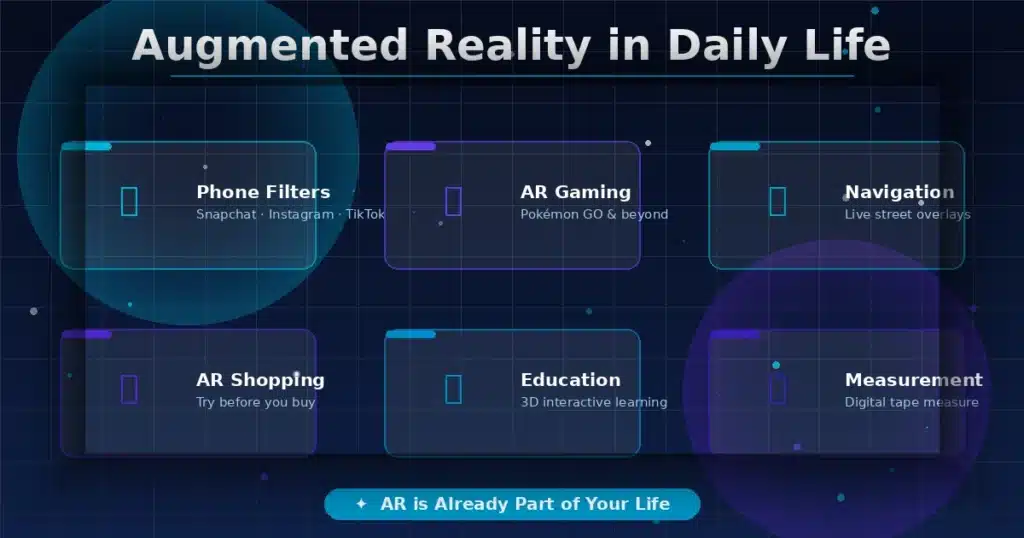
AR isn’t only something that happens in movies anymore. You probably already perform a lot of things that are related to it.
A lot of the filters on Snapchat, Instagram, and TikTok use augmented reality. The dog ears, the glitter on your face, and the virtual sunglasses are all examples of AR that works right away.
Do you remember when everyone went nuts over Pokémon GO? It uses your phone’s GPS and camera to make fictional animals appear in actual places around you. That’s the kind of AR game that a lot of people enjoy.
Some navigation apps now let you hold your phone up while you walk and see arrows projected right onto the street view that indicate you where to go. It’s a lot easier than trying to read a map while you walk.
Shopping Preview Apps – Warby Parker and other stores let you use the front camera on your phone to preview how furnishings and glasses will look on you. You can “try on” a number of various lipstick hues at Sephora without having to touch anything.
Educational Apps—Picture this: you bring your phone up to a page in a book that shows the solar system. You can see the planets move and go around in three dimensions above the page. AR makes learning a lot more fun.
Measurement Tools — You may use Apple’s Measure app to measure things in the real world by just pointing your camera at them. You don’t need an actual measuring tape.
AR vs VR — What’s the Simple Difference?
Let’s make things clear right away because a lot of people mix these two up.
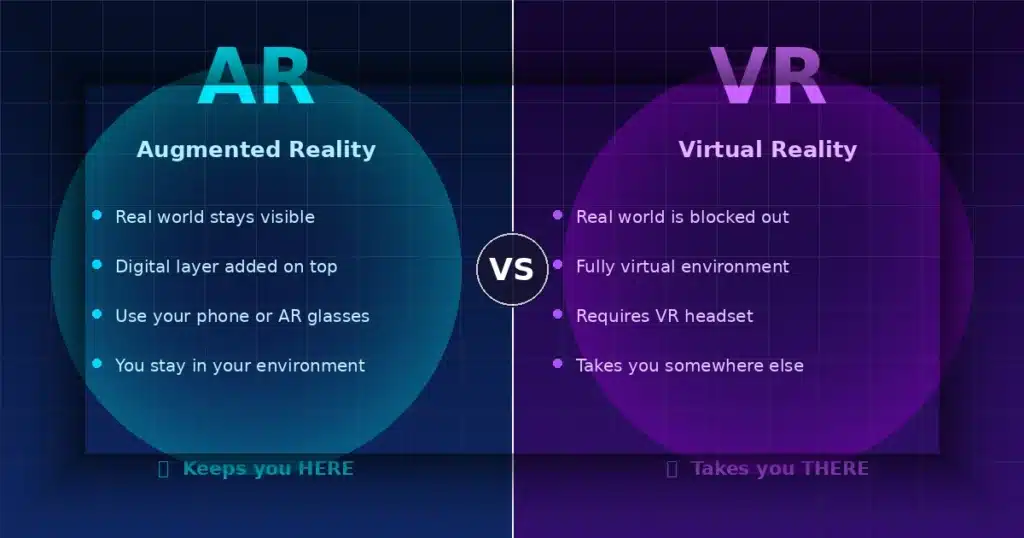
When you add digital elements to the real environment, that’s called augmented reality (AR). You can still see your hands and your flat, as well as everything else around you.
Virtual Reality (VR): A world that only computers can view. When you put on a headset, you enter a completely new universe. Your actual life is done.
AR keeps you in your area, which is a terrific way to remember it. VR takes you to a new place.
Both are cool pieces of electronics, but they do very different things. Augmented reality improves the real world. VR is now in charge.
Where Is Augmented Reality Being Used?
Augmented reality (AR) is no longer just for games and phone filters. Companies in many different sectors are coming up with new methods to exploit this technology.
Shopping and Retail—Brands use AR to let shoppers see how products will look in their homes or on their bodies before they buy them. This makes people more sure about what they buy, which means fewer returns.
Education—Schools and websites that teach online use AR to assist students learn hard topics. AR makes things that are hard to understand real and easy to view, including how molecules work together, things that happened in the past, or the human body.
Surgeons in health care wear AR headsets that show them crucial information about their patients and 3D anatomical guides on top of what they are doing. Medical students utilise AR to practise procedures in a safe, artificial environment.
Manufacturing and Engineering—People who work in factories use AR glasses that teach them how to put things together step by step. This speeds up training and lowers the number of blunders.
Navigation: Cars are employing AR to provide speed, directions, and warnings about dangers right on the windscreen. This is what a HUD, or heads-up display, is.
Gaming—AR gaming is one of the fastest-growing areas. The gaming industry has fully embraced this technology, from location-based games like Pokémon GO to AR escape rooms.
Benefits of Augmented Reality
What is it about AR that makes everyone so excited? It really does fix things and make them better.
Better visualisation: You can grasp something better when you can see it in your own environment or as a 3D model of a complicated machine.”Learning by doing” indicates that AR makes reading an active process of discovery, which helps people recall things better.
Safer training—Medical professionals, pilots, and emergency responders can use AR simulations to get ready for challenges that could happen in real life. A lot of people will find that very helpful.”Smarter shopping”—People feel better about what they buy and are less likely to regret their choices when they can virtually try things on and see how they look in their own homes.
Easier to go around—When you’re on the go, overlays and images make it easier to read maps and find your way.
More entertaining experiences—When people utilise AR to interact with museum exhibitions and marketing campaigns, they have more fun and remember more.
Challenges of Augmented Reality
Like all other technology, AR isn’t perfect yet. It still has to cope with some serious problems.
Limitations of devices—For AR to work successfully, the cameras, sensors, and computing power all have to be good. Some things don’t work well with AR, and the hardware that works best with it is still pricey.
Problems with accuracy—Sometimes, AR items don’t fit into the scene the way they should. They might float, wink, or move a little when you move, which makes it seem like they are real.
Battery drain—AR takes a lot of power from your phone or other device. Using graphics, computer vision, and real-time camera processing all at once will drain your battery quickly.
Concerns about privacy—People are apprehensive about what AR apps are collecting and who can see it because they are always on and scanning their surroundings. In the tech world, there still has to be a meaningful talk about this.
The Future of Augmented Reality
You won’t believe how cool AR is right now. In the next few years, things are going to get extremely insane.
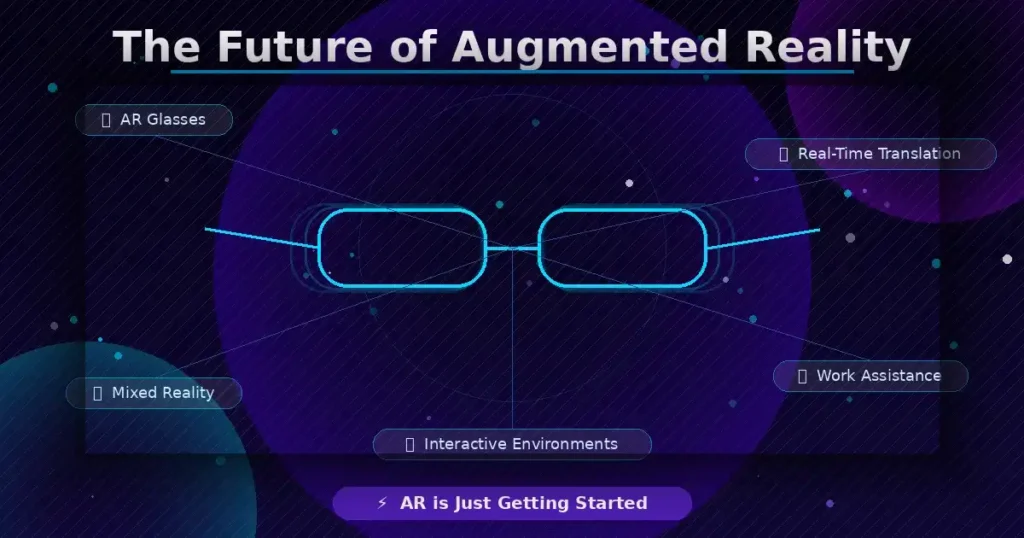
AR glasses are getting smarter, lighter, and more fashionable. Some firms, like Apple and Meta, are producing AR wearables that look like they came straight out of a movie.
When you wear AR glasses, you can read signs in other languages without even looking at them. Your glasses would automatically translate what you view as you go about.
At work, augmented reality (AR) is becoming more and more beneficial. Imagine having a professional advisor in front of you on a screen while you mend something or seek medical help.
Interactive AR environments—more and more malls, museums, and other public spaces will use AR to produce experiences that alter based on who you are and what you like.
Mixed reality spaces—the barrier between the actual world and the digital world will keep getting less obvious. In the future, businesses, schools, and places of entertainment might all adopt permanent AR overlays. Everyone in the room could see and utilise them all at the same time.
Frequently Asked Questions About Augmented Reality
What is augmented reality in simple terms?With augmented reality, you can see digital things, like pictures, animations, or information, on top of the real world through a screen or glasses. It doesn’t change your real environment; it makes it better.
Is there a difference between AR and VR? No. AR adds to the real world, but you stay in it. VR creates a fake world and shuts out everything real. Think of augmented reality as a way to make the real world better and virtual reality as a way to escape it.
What are some real-world uses for AR? Augmented reality (AR) is used in games, shopping apps, navigation tools, social media filters, education, healthcare, manufacturing, and more. Every day, billions of people do it.
Can AR work on regular phones? Yes! Most new smartphones can handle augmented reality (AR) experiences. Android phones use Google’s ARCore platform, and Apple’s ARKit platform is used by iPhones. Many well-known apps already use these AR features that come with the phone.
What are the most popular AR devices? Smartphones and tablets are the most common AR devices at the moment. There are also AR headsets made just for that purpose, such as the Apple Vision Pro, the Microsoft HoloLens, and Meta’s AR glasses. For now, though, these are more specialised and cost more.
Final Thoughts
Augmented reality puts digital information into the real world around us. It doesn’t change reality; it makes what we already see and do better.
To put it simply, AR makes it look like technology is right in front of you in real life. For instance, you could use a Snapchat filter at lunch, an arrow to help you find your way on your evening walk, or a 3D sofa in your living room before you buy it.
This story is still in its early stages. Augmented reality is going to change a lot of things about how we work, shop, learn, and play. The hardware will get better, the software will get smarter, and the experiences will get better.
And the best part is? You live in a world that is already augmented. You might not have known what to call it until now.
