
How AI Understands Images Like Humans: The Science Behind Computer Vision
Picture this. You snap a photo of your lunch, and before you’ve even put your phone down, your camera app has already named the dish, tagged your friend’s face in the background, and suggested a filter. You didn’t ask it to do any of that. It just knew.
Or maybe you pointed your lens at a dog in the park — a golden retriever, sun-warmed and joyful — and the app whispered back: Golden Retriever. 94% confidence. Like it had been watching the world long before you ever opened the camera.
We live so close to this magic now that we’ve almost forgotten to be amazed by it.
But here’s the question that ought to stop us in our tracks:
How does a computer actually understand what it is seeing?
Not feel. Not sense. Not know, the way you know your grandmother’s face from across a crowded room. But understand — in that cold, calculated, deeply modern way that machines have made their own.
This, dear reader, is the ancient art of seeing — reimagined in silicon and code. This is computer vision, and it is quietly reshaping the world we inherited.
What It Means for AI to “See” an Image
Here’s the honest truth: AI does not see the way you and I see.
When you look at a photograph of a sunrise — all amber and rose spilling over old mountains — you feel something. Memory stirs. You think of mornings that have passed, of people who once stood beside you watching the same sky. Seeing, for humans, has always been a deeply personal act. It is layered with meaning that stretches back through generations.
A computer sees none of that.
What a computer sees when it looks at that same sunrise is a vast, orderly grid of tiny colored squares called pixels. Each pixel is just a number. Or rather, three numbers — one for red, one for green, one for blue. That’s it. The entire photograph, that whole golden morning, reduced to millions of little numerical addresses.
Think of it like an old mosaic from a cathedral floor. Up close, it’s just colored tiles. Step back far enough, and suddenly — a face. An angel. A story. AI image recognition works in reverse. It starts with the tiles and learns to find the story.
How AI Converts Images Into Data
Every image your phone has ever taken is, underneath its beauty, a spreadsheet.
A standard photo might be 4000 pixels wide and 3000 pixels tall. That’s 12 million pixels. Each pixel carries its three color values. So a single photograph becomes a grid of roughly 36 million numbers — all of them waiting to be read.
This is how AI sees images at their most fundamental level: as data. Pure, patient, mathematical data.
The colors blend together into patterns. A patch of sky becomes a cluster of high blue values, low red. A human face arranges itself into familiar gradients of warm tones, shadowed curves, two bright points where the eyes catch light. These patterns repeat across thousands, millions of images — and over time, the machine begins to recognize them. Not because it was told to. Because it was trained to.
There is something almost monastic about it, really. The long, quiet study of countless images. Learning the shape of the world through repetition.
What Is Computer Vision?
Computer vision is the field of artificial intelligence dedicated to teaching machines to interpret and understand the visual world.
It sounds simple, stated that plainly. But it is one of the most ambitious projects in the history of technology — an attempt to replicate in code what evolution spent millions of years building into our eyes and brains.
The applications are already woven into daily life in ways our grandparents could never have imagined:
- Facial recognition unlocks your phone each morning, recognizing the particular geometry of your face from a thousand different angles and lighting conditions.
- Self-driving cars scan the road in real time, distinguishing pedestrians from lamp posts, reading traffic signs, predicting the movement of other vehicles — all at highway speed.
- Medical imaging AI studies X-rays and MRI scans, flagging potential tumors or abnormalities that a tired human eye might miss on a long shift.
These are not small things. They are pillars of a new kind of world — built on the foundation of machine vision technology.
How AI Learns to Recognize Objects
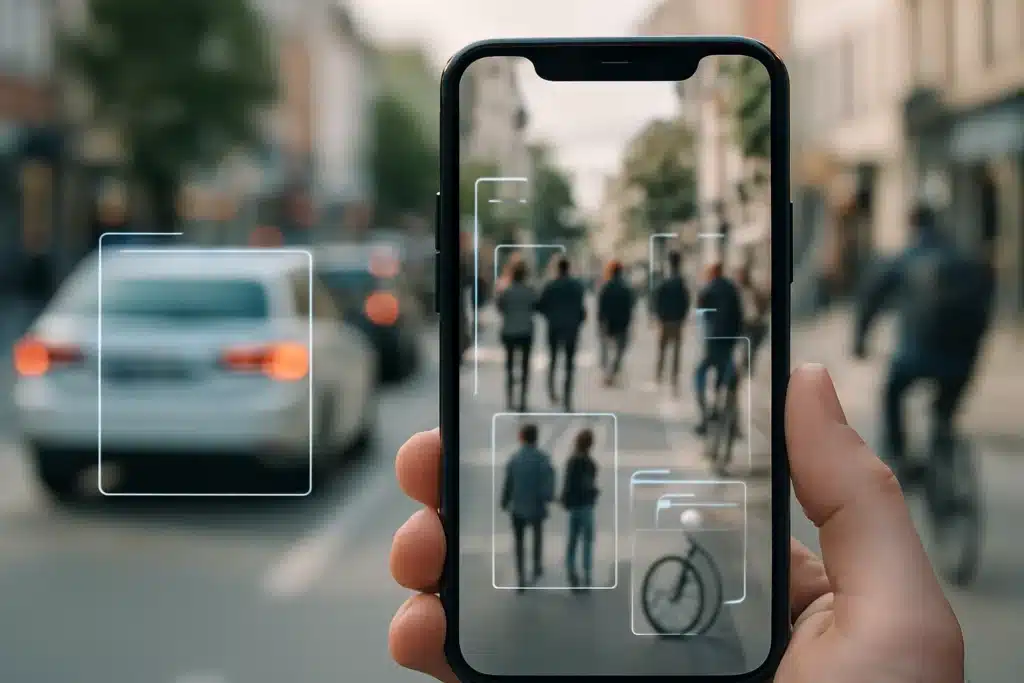
Here is where the real wonder lives.
AI does not come pre-loaded with knowledge. It does not emerge from its digital cradle already knowing what a cat looks like, or a stop sign, or a ripe mango. It has to learn. And the way it learns feels almost childlike in its simplicity — and almost divine in its scale.
Researchers feed the AI hundreds of thousands of labeled images. Photos of cats, tagged: cat. Photos of dogs, tagged: dog. Cars, trees, faces, clouds — each one named, sorted, catalogued with the patience of old monks copying manuscripts.
The AI studies them. It makes guesses. It gets things wrong. It is corrected. It tries again.
Over millions of iterations, it begins to notice: cats tend to have pointed ears. Cats have whiskers. Cats have a particular eye shape. Not because anyone spelled that out. Because the pattern revealed itself through sheer repetition.
This is AI recognizing objects through what we call supervised learning — one of the most powerful tools in modern machine vision. It is learning the way humans once learned almost everything: through observation, repetition, and gentle correction over time.
How Neural Networks Analyze Images
The engine running all of this is called a neural network — and it is, in its humble way, a tribute to the human brain.
A neural network processes an image in layers, each one looking for something different.
The first layers are simple. They scan for edges — places in the image where color or brightness changes sharply. The boundary between a cheek and the shadow behind it. The line where a road meets a curb.
The middle layers grow more complex. They start assembling those edges into shapes — curves, rectangles, circles. A wheel. An eye socket. The arch of a doorway.
The deeper layers go further still. They combine shapes into objects — a face, a car, a cup of coffee steaming on a wooden table.
It is like reading a poem. First you learn the alphabet. Then the words. Then the sentences. And only at the end — if you have studied long and hard enough — do you begin to feel the meaning.
Each layer passes its findings to the next, like elders passing knowledge down through generations, until finally the network arrives at its answer: This is a dog. This is a fire hydrant. This is a human hand.
Real Examples of AI Image Recognition Today
The technology has moved out of the laboratory and into the everyday, into the ordinary moments of ordinary lives.
Smartphone cameras now do far more than capture light. They detect faces and adjust focus accordingly, recognize scenes (beach, night sky, food, text) and optimize settings automatically, even restore old or blurry photos using AI that has studied thousands of examples of what sharpness looks like.
Google Photos lets you search your entire camera roll by typing a word — beach, birthday cake, my dog — and AI image recognition scours every pixel of every picture to find a match. It is retrieval through pattern, memory through machine vision.
Security systems in airports, stadiums, and city centers use computer vision to monitor crowds, flagging anomalies or matching faces against databases in real time. A watchful eye that never sleeps, never tires.
Autonomous vehicles are perhaps the most dramatic stage for machine vision technology today — cars threading through traffic using cameras and sensors, interpreting a world that was not designed for them, trying to learn the old human grammar of the road.
Why AI Sometimes Makes Mistakes
For all its speed, for all its pattern-hungry power, AI is not infallible. It carries within it the limitations of its making.
Unusual images trip it up. An AI trained mostly on photographs of dogs in ordinary lighting may struggle with a photo of a dog in deep shadow, or a dog in an unusual pose. The pattern breaks, and the confidence falters.
Lighting changes everything. A face that scans perfectly under good light may confuse the system entirely under a neon glow or in the flash-washed dark of a party photo.
And most sobering of all: bias in training data can lead to bias in the machine. If the images used to train an AI skew toward certain faces, certain scenes, certain kinds of beauty — then the AI will carry that skew forward into the world, blind to its own blind spots.
This is the old lesson, dressed in new language: what we teach shapes what we see. Garbage in, garbage out, as the old programmers used to say. And in our choices of what to teach these machines, we encode our own histories, our own limits.
It is a humbling reminder that technology does not stand apart from human nature. It is built from it.
The Future of AI Vision Technology
And still, the field moves forward — with the quiet, relentless momentum of a river finding its way downhill.
In healthcare, AI vision is being trained on medical scans from around the world, learning to detect cancers earlier than any human eye, offering doctors a second opinion that never gets tired. It is not replacing the healer; it is sharpening the tools.
In robotics, machines are learning to navigate physical space — to reach for an object on a cluttered shelf, to move through a room without knocking things over, to understand the physical world the way a cautious apprentice learns a craft. Slowly. Carefully. With a great deal of practice.
In smart cities, AI vision will help manage traffic flows, monitor public infrastructure, guide emergency services to where they are needed most. The ancient dream of a well-ordered city, pursued now through cameras and code.
There will be missteps, as there always are with new tools. There will be questions — about privacy, about surveillance, about who holds the power to watch. These are questions worth asking, loudly and often, in the old tradition of citizens who knew that vigilance is part of living in a community.
But the technology itself is, at its core, an act of extraordinary wonder. The attempt to teach a machine to see. To look at the world and recognize it.
The Quiet Revolution Happening in Every Camera Roll
Here is the realization we arrive at, after all of this:
AI does not truly see the way you see. It does not feel the warmth of a photograph, does not carry the weight of memory behind its gaze. It has learned, through tireless study of millions of images, to recognize patterns at a speed and scale that no human mind could match.
But in doing so, it has become something genuinely new in the world — a kind of vision that complements our own. A tireless student of the visual world, cataloguing the shapes and patterns of existence with a dedication that would humble even the most patient scholar.
And that technology — that quietly extraordinary machine vision — is already at work in your pocket, in your car, in the systems that keep your city running.
It is seeing the world. Not the way you see it. But in its own way.
And it is learning, still, every single day.
