
Does GPS Need Internet? The Day My Map Worked Without Signal
The road twisted through the Cascade Mountains like a ribbon someone forgot to iron flat. Pine trees crowded both sides, their branches forming a tunnel of green overhead. My phone sat in the cup holder, its screen glowing with that little blue dot—my location—inching forward along the map route.
Then I noticed it. No signal bars. Not a single one.
I picked up the phone, squinted at the empty space where my network strength usually lived, and felt that familiar flutter of modern panic. No internet. No data connection. The kind of digital silence that usually means you’re about to be very lost.
But the map kept working. The blue dot kept moving. Turn-by-turn directions kept coming through the speaker: “In 500 feet, turn right.”
I remember pulling over at a scenic overlook, the engine ticking as it cooled, staring at my phone like it had just performed a magic trick. The map showed exactly where I was—a tiny speck on a mountain road in the middle of nowhere. No signal. No internet. No explanation I could understand.
How was this still working?
The Common Belief We All Have
Most of us carry around a simple assumption: if you want to navigate somewhere, you need internet. Maps are apps. Apps need data. Navigation needs a network. It’s the digital food chain we’ve all accepted.
I certainly believed it. I’d seen what happens when you drive through a dead zone—the endless loading wheel, the frozen map, that awful moment when your route disappears mid-turn. We’ve all been there, right? Standing on a street corner, waving your phone around like a divining rod, hoping to catch one bar of signal to figure out which way you’re supposed to walk.
So when my map worked without any signal, it felt like watching your car run without gas. Impossible. Confusing. Maybe a little bit wonderful.
But here’s what I didn’t understand then: I was confusing two completely different things. The map and the location. The picture and the dot. The downloaded image of streets and the real-time knowledge of where I was standing on those streets.
They’re not the same thing at all.
The Invisible Conversation With the Sky
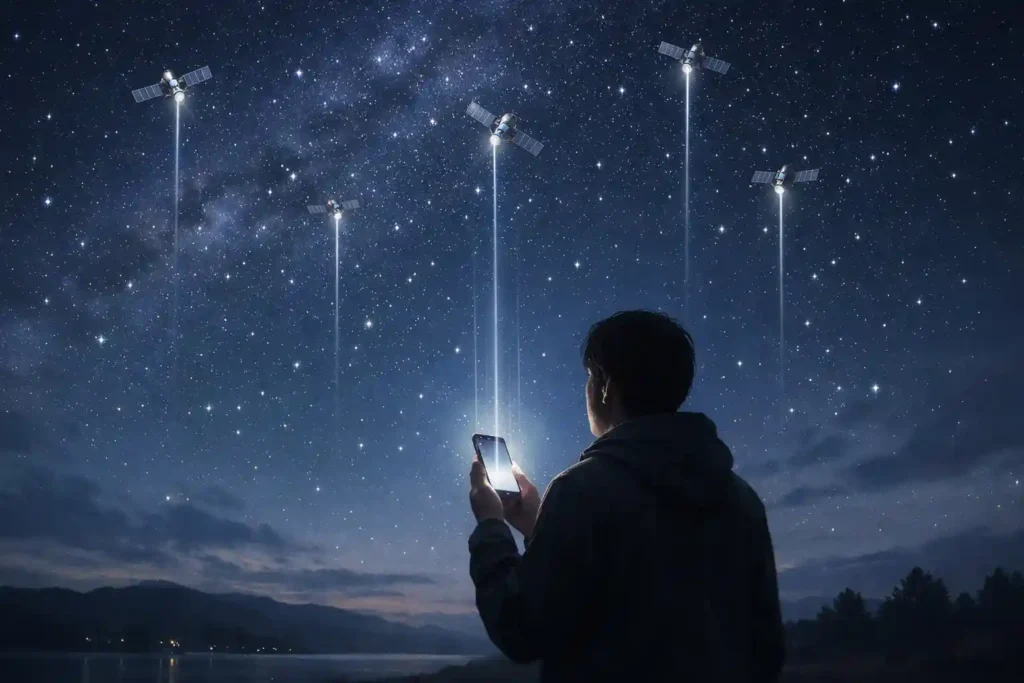
Your phone, right now, wherever you are—even if every network tower suddenly disappeared—is having a conversation. Not with cell towers. Not with WiFi routers. Not with anything on the ground at all.
It’s listening to space.
There are satellites up there, about 20,000 kilometers above your head, circling the planet every twelve hours. They’re part of something called the Global Positioning System—GPS—and they’re constantly broadcasting signals down to Earth. Not to any phone specifically. Just… outward. Like lighthouses sending beams into the dark, whether or not any ships are watching.
Your phone is listening for those whispers from space.
Each satellite is essentially saying the same thing over and over: “I am here. The time is now.” That’s it. No internet connection required. No monthly subscription. No data plan. Just satellites talking to anyone who cares to listen, broadcasting their identity and their precise timing.
And your phone? It’s designed to catch at least four of these whispers at once.
How GPS Actually Finds You Without Internet
Remember being a kid, trying to figure out where your friend was hiding by having them yell? You’d call out, and they’d respond, and you’d use the sound—how loud it was, how long it took to reach you—to guess their location.
That’s basically what your phone does with satellite navigation, but infinitely more sophisticated.
When your phone receives a signal from a GPS satellite, it can calculate how far away that satellite is. The signal travels at the speed of light, and because the satellite broadcasts its exact time and position, your phone can figure out: “Okay, this signal took X milliseconds to reach me, so I’m Y kilometers from this satellite.”
One satellite tells you you’re somewhere on a sphere of possible locations around it. Two satellites narrow it down to a circle where those spheres intersect. Three satellites give you two possible points. Four satellites—and this is the magic number—pinpoint your exact location on Earth.
No internet. No cell towers. No WiFi. Just your phone doing complex math with signals from space, triangulating your position using pure geometry and physics.
The GPS signals themselves work without data because they’re radio waves, traveling through the air like invisible light. Your phone doesn’t need to send anything back. It just listens, calculates, and knows.
What the Internet Really Does in Maps
So if GPS works without internet, why does my map app always seem to need a connection?
Here’s where the confusion lives. The position—that blue dot showing where you are—comes from satellites. But the actual map, the picture showing streets and buildings and points of interest, that usually comes from the internet.
Think about it like this: GPS tells you your coordinates. The internet shows you what’s at those coordinates.
When I loaded my map app that morning before leaving civilization, I’d done something without realizing it. The app had downloaded the map data for my route while I still had signal. It tucked those images into my phone’s memory—the roads, the landmarks, the terrain. So when I lost internet connection in the mountains, the map was already there. The GPS just had to place my blue dot on it.
This is why you can search for “pizza near me” only when you have internet, but the dot showing your location on a previously loaded map keeps working. Searching requires data. Real-time information about traffic or new restaurants requires data. Loading detailed map imagery requires data.
But knowing where you are? That’s between you and the satellites. That conversation happens offline, in the space between Earth and orbit, regardless of whether you’re streaming music or completely disconnected from the digital world.
Why GPS Still Works in Airplane Mode
I tested this once on a flight. Before takeoff, curious and slightly mischievous, I switched my phone to airplane mode. All the wireless signals cut out—cellular, WiFi, the works. Everything except GPS.
Even at 35,000 feet, my phone knew where we were. I watched our progress across the digital map, the plane’s path drawing itself across states and cities. No internet. No cell connection. Just GPS, faithfully tracking our journey through the sky.
Airplane mode doesn’t turn off GPS because GPS doesn’t transmit anything that could interfere with aircraft systems. It only receives. Your phone is just listening, catching those satellite whispers, doing quiet math to determine position.
It’s like being at a concert. You can hear the music whether or not you’re allowed to use your phone. The band doesn’t need to know you’re there for you to experience the performance.
When GPS Without Internet Feels Magical
There’s something deeply reassuring about GPS working without a network. Something that feels almost rebellious.
I’ve used offline GPS hiking trails where the nearest cell tower was probably twenty miles away. I’ve watched that blue dot navigate desert roads where the only signs of civilization were tire tracks in sand. I’ve seen sailors using phone GPS far out at sea, their location updating smoothly even though the nearest WiFi was back at the harbor.
My friend once got caught in a backcountry snowstorm. No signal. No way to call for help. But her phone GPS kept working, showing her exactly where she was relative to the trail she’d downloaded before the hike. It didn’t save her directly—she had to hike out on her own—but knowing she wasn’t lost, knowing she could verify her position and direction, that made all the difference between fear and calm determination.
These are the moments when you realize how remarkable this technology is. How we carry around devices that can talk to machines orbiting in space, can pinpoint our location anywhere on Earth, can function completely independently of cell networks or internet connections.
It’s navigation that can’t be taken away by a dead zone or a maxed-out data plan or a forgotten WiFi password.
When GPS Without Internet Struggles
But GPS isn’t magic. It has its quiet limitations.
Drive into a tunnel, and watch your blue dot freeze. The concrete and earth block the satellite signals, and suddenly your phone goes deaf to space. It might guess where you are based on the direction you were heading, but it can’t know for sure until you emerge back into open sky.
Dense forests can scatter GPS signals. Tall buildings in city centers create what engineers call “urban canyons”—places where signals bounce off glass and steel, confusing your phone about exactly where you are. You might notice your location jumping around, your blue dot dancing between streets, uncertain.
And indoors? Forget it. Most buildings block enough of the satellite signals that GPS becomes unreliable at best. Your phone might switch to WiFi or cellular tower triangulation to estimate your location, but that’s different. That’s not the pure GPS conversation anymore.
GPS needs a clear view of the sky. It needs to hear those satellites speaking. It works best outdoors, in open spaces, where nothing stands between your phone and the orbit above.
The Quiet Technology We Rarely Notice
We’ve become so accustomed to GPS that we’ve stopped marveling at it. We tap a destination into our phones and expect to be guided there. We trust it completely, following turn-by-turn instructions without questioning how any of it works.
But occasionally—maybe when you’re in the mountains with no signal, or when someone asks you a question like “does GPS need internet?”—you pause and actually think about it. You realize you’re holding a device that communicates with satellites in space. That NASA-level technology has become so ordinary we carry it in our pockets without a second thought.
Every time you open a map app, every time you check your location, every time you tap “navigate home,” you’re participating in something extraordinary. Dozens of satellites orbiting overhead, broadcasting signals that your phone catches and decodes, performing calculations that would have taken teams of mathematicians hours to complete, all happening invisibly in milliseconds.
And it works whether you have internet or not. Whether you’re connected to the digital world or completely off the grid.
So… Does GPS Need Internet?
The answer is simpler than it seems:
No, GPS doesn’t need internet to tell you where you are. The location tracking—that blue dot, those coordinates—comes from satellites. It works offline, in airplane mode, in the middle of nowhere with zero bars of signal.
But yes, you need internet for many features we associate with GPS and navigation. Real-time traffic updates. Searching for addresses. Loading new map regions. Finding nearby restaurants. Live public transit information. All of that requires data.
The confusion makes sense. Most of us use location and maps together, as one combined experience. We don’t think about the separation between position (from satellites) and map content (from the internet). We just know it works, until suddenly it doesn’t, and we’re not sure why.
Think of it this way: GPS is like having a compass that tells you exactly where you are on Earth. The internet is like having a constantly updating guidebook that tells you what’s around you and how to get places. The compass works on its own. The guidebook needs connection and updates.
Final Scene
I’m back in my car on that mountain road, phone in hand, staring at the empty signal bars and the steadily moving blue dot.
Now I get it. The satellites are still up there. Still broadcasting. Still letting my phone calculate its position through pure geometry and radio waves. The map loaded while I had signal, storing the visual information I needed for the route ahead.
Internet or no internet, the conversation with space continues.
I put the phone back in the cup holder and keep driving. The voice guidance continues: “In one mile, turn left.” The dot inches forward. The satellites keep whispering their locations to anyone listening.
And I realize something kind of wonderful: in this moment, on this empty mountain road with no cell towers in sight, my phone isn’t talking to the digital world at all. It’s talking to space.
That’s not the connection we think about when we think about being connected. But it’s there. Always there. Orbiting overhead, waiting to tell us exactly where we are, whether we have internet or not.
Sometimes the most important conversations happen in silence.
