
Can GPS Work Without SIM Card? The Time My Old Phone Still Knew the Way
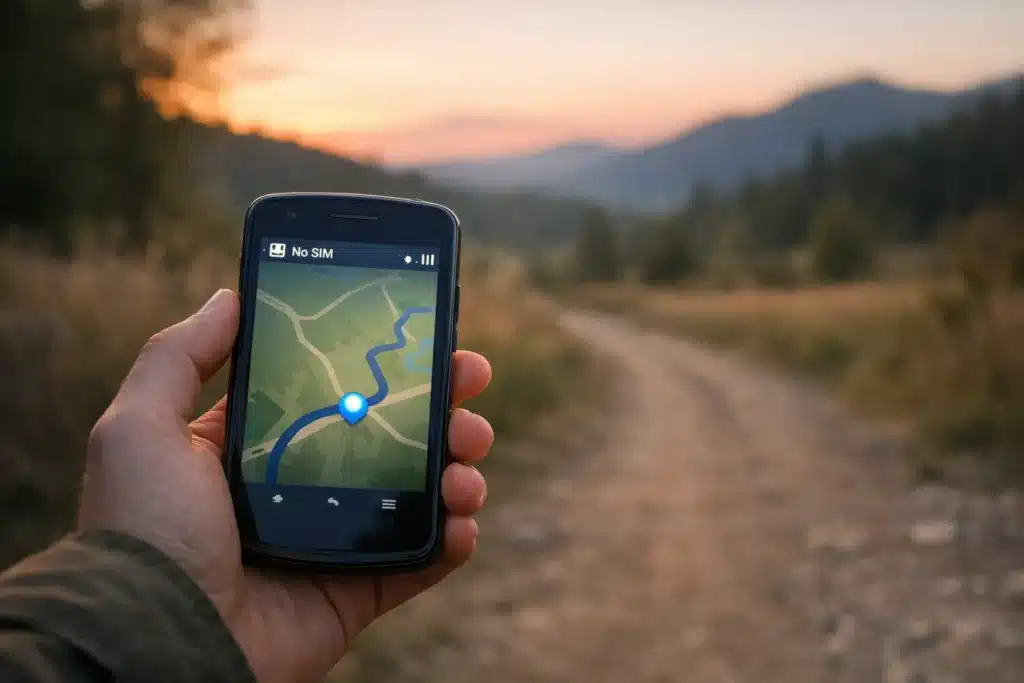
The morning light filtered through the forest canopy as I stood at the trailhead, patting my pockets with growing concern. My main phone sat at home, charging after I’d forgotten it overnight. All I had was my old phone—the one I’d retired months ago, its SIM card long removed and given to my nephew.
No network bars. No little LTE symbol. Just a blank space where connection used to be.
I opened the maps app anyway, more out of habit than hope. And there it was: a blue dot, pulsing gently on the screen, showing exactly where I stood. The hiking trail stretched ahead on the map, winding through the mountains I was about to climb.
I stared at that glowing dot. How does this phone still know where I am?
The Assumption We All Make About Phones
We’ve all absorbed this belief without really thinking about it: phones need a SIM card to work. The SIM connects us to the network, and the network connects us to everything—calls, messages, the internet, and surely our location, right?
It’s such a natural assumption. When you pull out a SIM card, the phone loses its bars. It can’t call anyone. It can’t load a webpage. It feels disconnected from the world. So of course it shouldn’t know where you are anymore. That makes sense.
Except it doesn’t work that way at all.
The Sky Above Us That Phones Listen To
Here’s something quietly beautiful: your phone doesn’t only look down at cell towers to find itself. It looks up.
Imagine your phone as a listener, cupping its hands toward the sky like someone trying to hear a distant melody. High above the Earth—about 12,000 miles up—a constellation of satellites circles the planet. They’re not communication satellites sending your texts or streaming your videos. They’re GPS satellites, and they do one thing endlessly: broadcast their precise location and the exact time.
Your phone receives these whispers from space. From at least four satellites, ideally more. And by comparing the tiny time differences in when each signal arrives, your phone calculates exactly where it must be standing on Earth.
No SIM card involved. No cellular network needed. Just mathematics and satellites and the patient work of triangulation.
How GPS Works Without SIM Card
Think of it like this: you’re standing in a plaza, and four different church bells ring at noon. But you hear each bell at a slightly different moment—one instantly, another a heartbeat later, the next after a breath. From those differences in arrival time, if you know where each bell tower stands, you could work out exactly where you’re standing in the plaza.
That’s what phone GPS without SIM does, but with satellites instead of bells.
The GPS satellites send signals at the speed of light. Your phone measures how long each signal took to reach you. Satellite A might be 11,000 miles away. Satellite B might be 13,000 miles. Satellite C and D each at different distances. Those measurements create invisible spheres around each satellite, and where all those spheres intersect—that’s you. That’s your exact position on Earth.
The beautiful part? This entire conversation happens between your phone and space. The cellular network never enters the discussion. Your SIM card sits uselessly in a drawer somewhere, completely unnecessary for this particular magic.
What a SIM Card Actually Does
Let’s clear this up gently, because the confusion is understandable.
Your SIM card is your phone’s membership card to the cellular network. It’s what lets you make calls, send texts, and use mobile data. When you see those bars on your screen, that’s your SIM card saying, “I belong here. Let me connect.”
The network does amazing things. It routes your calls across continents. It pulls down websites and videos. In many situations, it can even help determine your location—but through a different method than GPS. Cell towers triangulate your position based on signal strength, giving a rougher estimate of where you are.
But GPS? GPS doesn’t care about any of that. GPS is a separate system entirely, a completely different technology that existed before smartphones, before the internet, before cell phones themselves. It’s a space-based navigation system that works independently, asking nothing of cellular networks.
Think of them as two different senses: GPS is your phone’s ability to see the stars and know where it stands. The cellular network is its ability to talk to other phones. One doesn’t require the other.
Why My SIM-Less Phone Still Navigated Roads
Back on that trailhead, I started walking. The blue dot moved with me. The trail path on the screen matched the dirt path under my feet. Turn after turn, the phone knew exactly where I was going.
Here’s what was happening: before retiring that old phone, I’d downloaded offline maps for this region. Apps like Google Maps, Maps.me, and dozens of others let you save map data directly to your device. The entire geography—roads, trails, landmarks—sits quietly in your phone’s storage, asking nothing of the internet.
So my phone’s GPS receiver was catching those satellite signals, calculating my position every second. And the offline map was the canvas on which that position could be displayed. Together, they created a complete navigation system. No SIM card. No data connection. Just satellites, mathematics, and downloaded cartography.
I could see where I was. I could see where I was going. The phone offered turn-by-turn guidance at intersections. All of it working perfectly in the silence of no cellular signal.
When GPS Without SIM Works Perfectly
This independence of GPS opens up entire worlds of possibility.
Traveling abroad? Pop out your expensive SIM to avoid roaming charges, drop in a cheap local one, or use no SIM at all. Your phone still tracks your location. You can still navigate foreign streets with downloaded maps, finding your way through winding medinas and mountain villages without spending a cent on data.
That old tablet gathering dust? Without a SIM slot or cellular plan, it can still be a dedicated navigation device for your car. Download the maps, mount it to your dashboard, and let GPS satellites guide you.
Hiking in remote areas? Places where cell towers don’t reach and phones show “No Service”? GPS works beautifully there. Those satellites broadcast from space—they don’t care about terrain or infrastructure. Mountains, deserts, forests, open ocean: if you can see the sky, you can receive GPS signals.
Even airplane mode, that switch we flip for flights, doesn’t stop GPS. Airplane mode blocks transmitting signals—calls, texts, wifi—but receiving signals? That’s passive. Your phone can still listen to those satellite whispers without breaking any rules.
When GPS Without SIM Feels Limited
But let’s be honest about the trade-offs, because they matter.
Without a SIM or data connection, you lose the living, breathing internet. That means no live traffic updates. Your phone won’t warn you about the accident three miles ahead or suggest a faster alternate route. The map shows roads, but not what’s happening on those roads right now.
You can’t search for nearby restaurants or gas stations. Well, you can try, but the search requires internet. The phone knows where you are, but it can’t reach out to Google or Yelp to find what’s around you.
Your maps don’t update automatically. If a new road opens or an old one closes, you won’t know until you manually download fresh map data when you’re back on wifi.
And messaging someone your location? Checking in? Sharing your real-time position? All of that requires network connection. GPS tells you where you are, but without a SIM or data, that information stays private to your phone.
These limitations aren’t failures of GPS—they’re simply the natural boundary between receiving satellite signals and connecting to the internet. Two different systems, two different capabilities.
The Hidden Independence of GPS
There’s something quietly reassuring about this independence.
We’ve become so accustomed to constant connectivity, to phones that need permission and authentication and network handshakes for everything, that it’s startling to encounter a feature that just works. Silently. Independently. Asking nothing.
GPS is old technology by smartphone standards—decades old—and maybe that’s why it feels more solid. It was designed for a different era, when reliability mattered more than connectivity. Military origins, yes, but opened to civilian use with the promise of free, accurate positioning for anyone with a receiver.
Your phone doesn’t need to ask permission to receive those satellite signals. It doesn’t need to pay a subscription or authenticate an account. The satellites broadcast constantly, openly, to anyone listening. It’s one of the last genuinely free services in our increasingly monetized digital landscape.
So… Can GPS Work Without SIM Card?
Yes. Absolutely, completely, definitely yes.
GPS works without a SIM card because it operates on an entirely different system. It’s space-based, not network-based. Your phone receives signals from satellites orbiting Earth, and from those signals, it calculates your precise location. The cellular network plays no role in this process.
You can navigate with GPS, track your location, and record your routes without ever having a SIM card in your phone. Download maps beforehand for the full experience, but even without downloaded maps, your phone still knows exactly where it stands on the planet.
The only things you’ll miss are the internet-dependent features: live traffic, online search, map updates, and location sharing. But the core function—knowing where you are—works perfectly without any network connection at all.
Why This Matters More Than We Realize
Understanding this changes how we think about old devices and backup plans.
That retired smartphone sitting in your drawer? It’s still a perfectly capable GPS device for hiking, cycling, or travel. No need for an active plan or even a SIM card at all.
Planning international travel? You can navigate confidently without expensive roaming plans, relying on downloaded maps and satellite navigation.
Emergency situations? If cellular networks fail but satellites keep broadcasting (which they do, reliably), GPS continues working. Your phone can still help you find your way.
There’s practical value in knowing your devices are more capable than you thought, that they have independence built into them, quiet capabilities that work even when everything else fails.
The Old Phone That Still Remembers
I finished that hike hours later, the old phone having guided me perfectly through every fork in the trail, every uncertain junction. When I returned to my car and drove home, it navigated those roads too, its blue dot moving confidently across the downloaded map.
Back home, I placed it next to my main phone—the one with its fancy SIM card and unlimited data and constant notifications. The old phone sat quiet and disconnected, its screen dark.
But I knew something now that I hadn’t known that morning: this device, even stripped of its network membership, even silenced and seemingly useless, could still hear the satellites singing overhead. It could still find itself in the world. It had never needed the network to know where it was.
Sometimes our tools are more capable than we realize. Sometimes the connection we think we need isn’t the connection that matters. And sometimes, the most reliable guidance comes not from the networks we build on Earth, but from the silent constellation wheeling overhead, broadcasting its patient truth to anyone willing to listen.
The sky has always known where you are. Your phone just learned to ask.
