
Will AI Replace Apps? The Future of App-Free Technology
Picture this. It’s a regular Tuesday morning, and before you’ve even had your coffee, you’ve already opened six different apps.
You checked the weather. You scrolled your banking app to see if your paycheck landed. You tapped into Google Maps to check the commute. Then food delivery for breakfast. Then your calendar to see what meetings are waiting. Then three different messaging apps because, well, everyone’s on a different one now.
By 9 AM, your thumbs are already tired.
Sound familiar? Most of us live this way — our days quietly carved up into little squares on a screen, each one demanding its own login, its own learning curve, its own small slice of attention.
But here’s the question that’s starting to echo through the halls of every major tech company in the world right now:
What if one AI assistant could do all of this for you — without you ever opening a single app?
Not five apps. Not ten. Just one conversation. One voice. One thread connecting you to everything you need.
That future, believe it or not, is already beginning. And it might change the way we live with technology more profoundly than the smartphone itself once did.
Why We Use So Many Apps Today
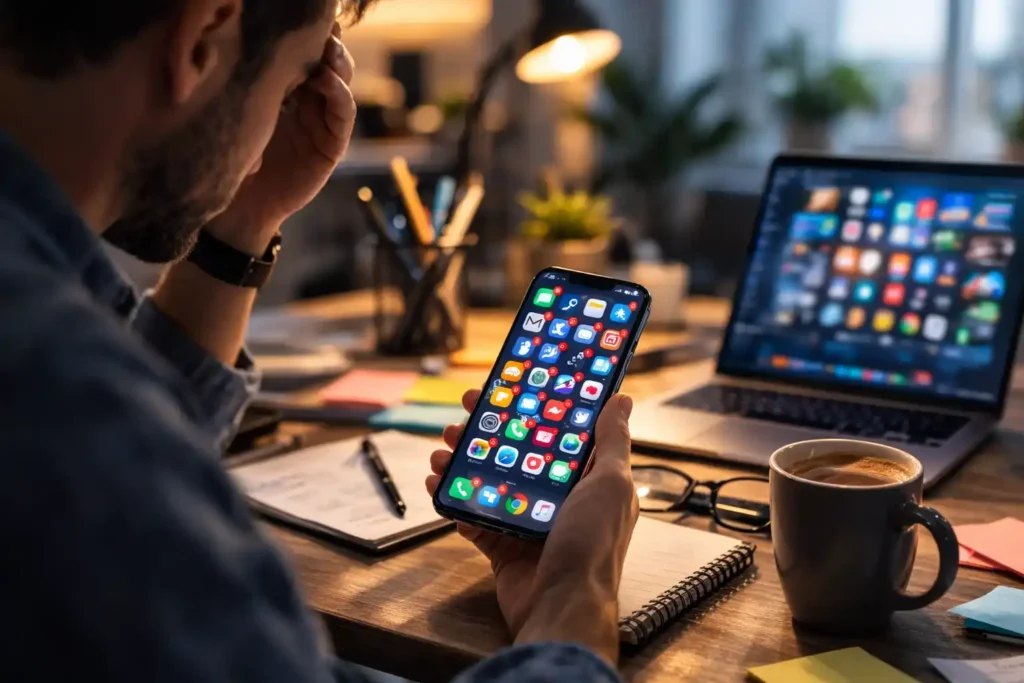
To understand where we’re going, it helps to appreciate where we’ve been — and there’s a certain beauty to how the app ecosystem grew.
When the App Store first opened its doors back in 2008, it was a revelation. Suddenly, your phone wasn’t just a phone. It was a shopping mall, a library, a bank, a travel agent, a restaurant guide — all folded into one sleek rectangle.
And so the apps multiplied. Shopping apps like Amazon and eBay. Banking apps for every financial institution under the sun. Travel apps like Kayak, Airbnb, and Google Flights. Communication apps — WhatsApp, Telegram, Slack, iMessage — each one holding a different corner of your social life hostage.
The average smartphone user today has somewhere around 80 apps installed, and uses about 9 of them daily. We’ve essentially built a second life inside our phones, with each app acting like a different room in a very, very cluttered house.
It worked. It works. But it’s also, if we’re being honest with ourselves, exhausting.
How AI Assistants Are Changing the Way We Use Technology
Here’s where the story starts to shift — and it’s a shift that feels, somehow, like coming home.
Instead of navigating menus and tapping through screens, imagine simply speaking your need into existence.
“Book me a flight to New York next Friday, something in the morning, and find me a hotel near Central Park under $200 a night.”
A modern AI assistant, given the right capabilities, doesn’t need you to open Kayak, then Google Hotels, then your calendar to check availability, then your banking app to confirm your budget. It can weave between all of those services invisibly — like a skilled concierge who knows exactly where to look and who to call.
This is the quiet revolution already happening with tools like ChatGPT, Google Gemini, Apple Intelligence, and Amazon Alexa’s newer iterations. They’re no longer just answering questions. They’re doing things — executing tasks, making decisions, acting on your behalf across multiple services at once.
The conversation is becoming the interface. And conversation, after all, is the oldest interface humanity has ever known.
What an App-Free Future Might Look Like
Close your eyes for a moment and imagine a typical day — but different.
You wake up and say, “What’s my day looking like?” Your AI assistant reads your calendar, checks the traffic, sees that your 10 AM meeting has a conflict, suggests a reschedule, and orders your usual coffee from the café down the street — all before you’ve reached for your phone.
At lunch, you say, “I want Italian tonight, something nearby, not too expensive.” It finds the restaurant, checks reviews, makes a reservation, and adds it to your calendar.
You need to send money to a friend. You say, “Send Jamie $40 for last night’s dinner.” Done.
You need to plan a weekend trip. “Find me something to do in the mountains this Saturday — hiking, maybe somewhere with good views.” It builds you an itinerary, complete with directions, weather forecast, and a packed lunch suggestion.
No app switching. No loading screens. No forgotten passwords. Just asking, the way you’d ask a trusted friend who happened to know everything and forgot nothing.
How AI Agents Could Replace Apps
Now, the deeper magic — the part that’s truly reshaping the technological landscape.
What makes this possible is something called AI agents — and they’re worth understanding, because they’re the engine behind the whole transformation.
An AI agent isn’t just a chatbot that talks back. It’s a system that can take action. It communicates with other services behind the scenes, the way a brilliant personal assistant might call a hotel, email a supplier, and update a spreadsheet, all on your behalf, without you needing to be in any of those conversations.
Think of it this way: the app was always just the visible surface of a deeper service. Uber, at its core, is a system that connects drivers and passengers. A sufficiently capable AI agent can connect to that same underlying system — without you ever needing to see the Uber app at all.
This is what researchers and developers mean when they talk about AI replacing apps. Not necessarily deleting the underlying services, but dissolving the apps themselves — the visual interfaces, the icons, the screens — into something invisible, something conversational, something that simply responds to you.
Why Tech Companies Are Building AI Agents
The fact that every major tech giant — Apple, Google, Microsoft, Meta, Amazon — is pouring resources into AI assistants and agent technology is not a coincidence. It’s a gold rush, and the gold is convenience.
The agent economy, as some futurists are calling it, promises a world where AI handles the friction of digital life on your behalf. Microsoft’s Copilot is being woven into Windows and Office. Apple Intelligence is beginning to tie Siri into third-party apps. Google’s Gemini is learning to book, browse, and act across the web.
The vision is clear: the AI assistant becomes the one relationship you have with technology, and everything else — every service, every platform, every app — exists in the background, responding to the assistant’s quiet commands.
For tech companies, it’s also a power play. Whoever builds the dominant AI interface becomes the gateway to everything. The new App Store won’t be a grid of icons. It might be a single conversation window.
Will Apps Completely Disappear?
Here’s where we take a breath and honor a more balanced truth — because history teaches us that old things rarely vanish completely. They transform.
Television didn’t kill radio. Email didn’t kill letters. Streaming didn’t kill vinyl (it came back, didn’t it?).
Apps, in their current form, may fade. The era of hunting through icon grids and juggling twelve different logins may genuinely be coming to a close. But the services behind the apps — the restaurants, the banks, the transport networks — those aren’t going anywhere.
What’s more, some experiences are just better with a visual interface. Editing photos. Playing games. Watching a movie. These might always want a dedicated screen, a dedicated space. And for the deeply private or deeply personal — perhaps some things will always feel better when you are the one holding the controls.
The future of mobile apps isn’t necessarily extinction. It’s more like retirement — graceful, unhurried, and long overdue.
What This Means for Smartphones in the Future

The smartphone as we know it — built around the app grid, the swipe, the scroll — may look radically different within a decade.
We’re already seeing hints of it. Devices like the Rabbit R1 and the Humane AI Pin launched (with mixed results, admittedly) as attempts at AI-first hardware — devices where the AI is the interface, not an app sitting on top of it.
The smartphone of 2035 might be a screen with almost nothing on it. One conversation window. One voice interface. Quiet as a library, powerful as a city.
Or perhaps the phone disappears too — into earbuds, into glasses, into the gentle hum of a device worn on the wrist. The form may change. The conversation will remain.
Benefits of an AI-Driven App-Free Experience
Let’s be clear about what we’d gain — because the gains are genuinely poetic in their simplicity.
Less clutter. No more home screens overflowing with apps you downloaded once and forgot. Your digital life, finally, breathing room.
Faster tasks. What takes four apps and eight taps today might take one sentence tomorrow. Time, that most irreplaceable of gifts, returned to you in small and meaningful portions.
Simpler living. There’s something quietly profound about a life where technology recedes into the background — present when you need it, invisible when you don’t. The way good infrastructure should work. The way a well-run home feels.
Fewer logins, fewer passwords, fewer moments of friction standing between you and what you actually want to do.
Possible Problems With Replacing Apps
And yet — wisdom asks us to look at both sides of the coin, as it always has.
Privacy is the great unresolved question. If one AI assistant touches every part of your life — your finances, your travel, your health, your relationships — that’s an extraordinary amount of trust to place in a single system, or a single company. The old ways gave us compartments. The new way collapses them.
Control is another. With an app, you see what’s happening. You make the choices, tap the buttons, confirm the actions. With an AI agent acting on your behalf, how do you know what it’s actually doing — or who it’s sharing your data with in the process?
Reliability matters, too. Apps go down sometimes. But when your single AI interface goes down, everything stops at once. The old redundancy of many apps was, in its way, a kind of resilience.
And finally, there’s the human question — the one the poets and the philosophers always raise: what do we lose when we stop doing things ourselves? When the friction disappears, does some meaning go with it?
These are questions worth sitting with. The future is always best entered slowly, with your eyes open.
The Future: One AI Assistant for Everything
Perhaps the most beautiful version of this future — and the most likely — is one of quiet elegance.
Not a world where everything is controlled by a faceless machine, but a world where technology has finally learned to listen. Where the interface is as natural as conversation. Where the distance between thinking a thought and having it taken care of is measured in seconds, not screen taps.
One AI assistant. One thread. All of it woven together behind the scenes, so that the surface of your life stays calm and clear — the way a great river looks still from above, even as it moves powerfully beneath.
The apps won’t announce their retirement. They’ll simply fade, like the sound of a distant bell, replaced by something softer and more responsive to the shape of your actual life.
And maybe that’s how all great progress works — not with a bang, but with a conversation that starts small, and one day, without your even noticing, has quietly answered everything you needed.
The future of technology isn’t about more apps, more screens, more notifications competing for your attention. It’s about less. It’s about an AI layer so seamless, so conversational, so woven into the background of daily life, that technology finally stops feeling like something you manage — and starts feeling like something that simply helps.
That future is already beginning. And honestly? It’s about time.
