
What Is the Bazaar Phase of AI? Why You Will Soon Own Your Own Algorithm
Right now, every time you type a question into an AI chatbot, your words travel hundreds of miles to a server farm owned by a giant tech company. That company’s computers think, respond, and — depending on the service — potentially store what you said. Your curiosity, your health questions, your financial worries: all of it passes through someone else’s machine.
That’s just how AI works today. But it doesn’t have to stay that way.
What if your AI belonged to you, not a company? What if it lived on your phone, learned your habits, and never sent a single word to anyone else’s server? That future is closer than most people realize — and the shift that gets us there has a name: the bazaar phase of AI.
How AI Works Today: The “Factory Phase”

To understand where we’re going, it helps to understand where we are.
Today’s AI runs almost entirely in the cloud. When you use ChatGPT, Google Gemini, or Claude, you’re essentially renting time on enormous computers housed in data centers around the world. These are not small machines. A single AI model can require thousands of specialized chips working in parallel just to generate one response.
Think of it like a massive factory. The factory is owned by one company. Millions of people line up outside, submit their requests through a little window, and get an answer back. The factory controls everything: the workers, the process, the output, and crucially, the data flowing through it every day. This is the factory phase of AI — centralized, company-owned, cloud-dependent.
It works remarkably well, and it gave us AI capabilities that seemed impossible just five years ago. But it has real trade-offs that are starting to matter a lot to everyday users.
What Is the Bazaar Phase of AI?
A bazaar is the opposite of a factory. Where a factory is controlled, centralized, and owned by one entity, a bazaar is open, distributed, and full of independent participants each doing their own thing. It’s a marketplace of many, not the production line of one.
The bazaar phase of AI describes the coming era where AI stops being something you visit on a company’s server and becomes something you own and run yourself. Instead of sending your data to a distant cloud, your personal AI model lives on your own device — your phone, your laptop, your home computer — and works entirely for you.
This concept sits at the heart of what technologists call decentralized AI: a world where intelligence is spread out among billions of personal devices rather than concentrated in a handful of mega-data-centers. Your AI. Your data. Your rules.
The term draws from a famous 1997 essay by software pioneer Eric Raymond called The Cathedral and the Bazaar, which compared centralized software development (cathedrals, built by a select few in secret) to open-source development (bazaars, built by many people openly). The same tension is now playing out in the AI world — and the bazaar is starting to win.
Factory vs. Bazaar: The Big Difference
The contrast between these two models comes down to three things: where the AI lives, who controls it, and who owns your data.
In the factory model, the AI lives in the cloud. You interact with a shared model trained on data from millions of users, owned and updated by a corporation. Every prompt you send leaves your device. Every response comes from outside it. You are a user of someone else’s tool.
In the bazaar model, your personal AI model lives on your device. It may be a smaller, leaner version of a larger model, or it may be one specifically trained or fine-tuned on your own information. It understands your preferences because you taught it — not because it scraped your emails while you weren’t paying attention. You don’t share it with anyone. It doesn’t send your conversations anywhere. You are the owner, not just the user.
The difference isn’t just philosophical. It’s practical. Local AI can work without an internet connection. It responds faster because there’s no round-trip to a distant server. And it can be customized to you in ways that a one-size-fits-all cloud model simply can’t match.
Why AI Is Moving Toward Personal Ownership
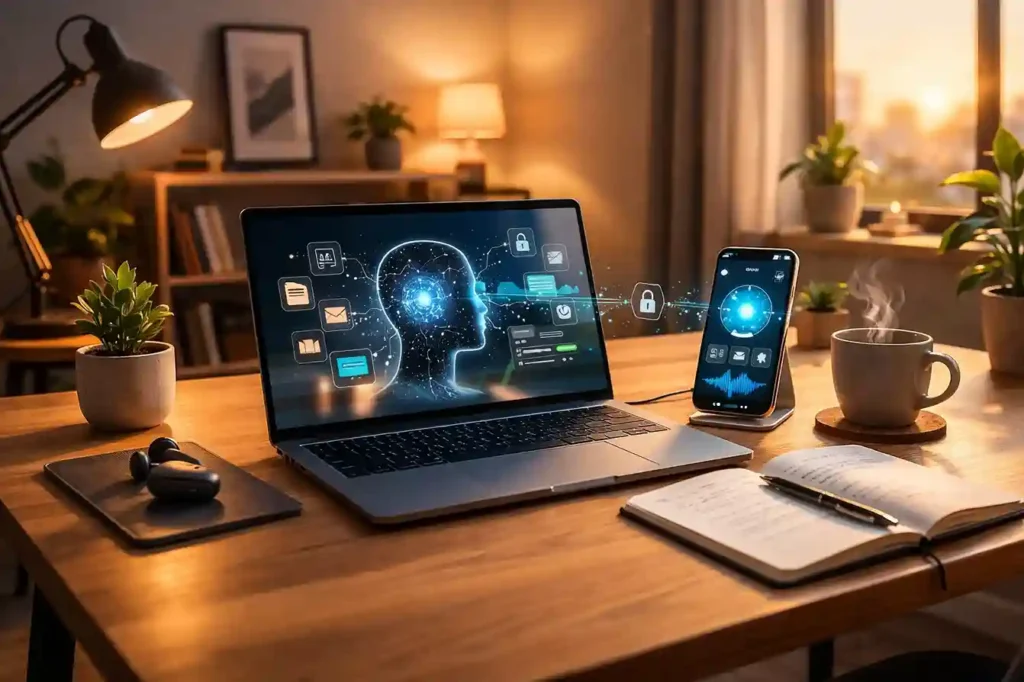
This shift isn’t wishful thinking. Several powerful trends are already pushing AI toward your pocket.
Smartphones are getting surprisingly powerful. The chip in a modern flagship phone is more capable than the computers that powered early AI research. Apple’s Neural Engine, Qualcomm’s AI-focused Snapdragon chips, and similar processors from Samsung and MediaTek are now specifically designed to run machine learning tasks efficiently. What once required a data center can increasingly run in your hand.
Edge computing is maturing. “The edge” is tech shorthand for the devices at the edge of a network — your phone, your laptop, your smart home hub — rather than central cloud servers. As edge hardware improves, running sophisticated AI at the edge becomes not just possible but practical.
Privacy concerns are reaching a tipping point. High-profile data breaches, concerns about how AI companies train their models, and growing regulatory pressure from governments around the world are making people far more cautious about what data they share. The demand for AI on device — AI that never phones home — is growing fast.
Open-source AI is flourishing. Models like Meta’s LLaMA family, Mistral, and dozens of others have been released publicly, allowing developers and researchers to run capable AI entirely offline. Tools like Ollama and LM Studio already let technically minded users run local AI models on their own computers today. The early bazaar is already open for business.
What Personal AI Models Might Do for You
Imagine waking up and asking your phone to summarize everything on your calendar, flag the emails that need urgent responses, and remind you that you have a doctor’s appointment — all without any of that information leaving your device.
Personal assistant AI is the most obvious use case. An AI that knows your schedule, your communication style, your preferences, and your history can serve you in ways that a generic cloud model never could — because it knows you.
Health AI becomes genuinely useful when it’s private. Tracking symptoms, medication schedules, or mental health patterns requires a level of intimacy that most people aren’t comfortable handing over to a corporation. A local model, running only on your device, changes that equation entirely.
Finance AI can help you track spending, flag unusual transactions, and model your savings goals — but only if you trust it with your financial data. With a personal model on your own device, you never have to wonder who else might see those numbers.
Memory AI might be the most transformative of all. An AI that has read your notes, your documents, your photos, and your past conversations can function as an extension of your own memory — finding that thing you wrote three years ago, connecting ideas across different projects, surfacing insights you’d forgotten you had. This is deeply personal work. It belongs on your device, not on a server in another country.
Privacy Advantages of Local AI Models
Privacy is probably the strongest argument for the bazaar phase, and it deserves its own moment.
When AI runs locally, your data stays local. Full stop. There are no terms of service to read carefully. There’s no policy update that quietly grants a company new rights to use your conversations for model training. There’s no data breach to worry about because there’s no external database holding your information.
AI ownership means you’re not the product. Today, many AI services are free or subsidized in part because the conversations you have help train better models — models the company then sells or monetizes. When you own your AI, that dynamic disappears.
Local models also give you control over updates. You decide when your AI changes. You can audit what it knows. You can delete its memory. In a world where AI is becoming woven into the most personal corners of our lives — our health, our relationships, our finances — that level of control isn’t a luxury. It’s a necessity.
Challenges of the Bazaar Phase
To be fair, personal AI ownership isn’t without its hurdles.
Hardware limits are real. The most capable AI models today are enormous. Running a truly powerful model locally requires significant processing power and memory that many older devices simply don’t have. While hardware is improving rapidly, there will be a gap for years between what you can do in the cloud and what you can do on your phone.
Updates and training are complex. Cloud AI models get better quietly in the background — you just notice one day that the responses are sharper. Personal models will need new mechanisms for improvement: ways to download refined model weights, ways to fine-tune on your data safely, and ways to do all of this without creating new privacy risks.
Not everything needs to be local. Realistically, the future is likely a hybrid. Sensitive personal tasks — health tracking, private journaling, financial planning — will run locally. Tasks requiring massive compute or real-time information — complex research, live data analysis — may still touch the cloud. The key shift is that you’ll have the choice of where your AI lives, rather than having no choice at all.
When Will Personal AI Become Normal?
The honest answer is: it’s already starting, and the next few years will accelerate it dramatically.
By 2026, expect significantly more capable on-device AI built into flagship smartphones and laptops. Apple, Google, and Microsoft are all investing heavily in running AI features locally as a privacy and performance advantage.
Between 2026 and 2028, look for a wave of consumer tools specifically designed around personal AI ownership — apps that let you train a model on your own documents, assistants that run entirely offline, and health or productivity tools built around the premise that your data never leaves your device.
By 2029 and 2030, the bazaar phase will likely feel mainstream. The idea of sending all your most personal queries to a distant corporate server may feel as strange as it once felt to store all your photos on someone else’s hard drive — before personal cloud storage normalized that too.
The infrastructure is being built right now. The open-source models exist. The hardware is catching up. What’s left is the consumer layer: the products and habits that make personal AI ownership feel normal.
What This Means for the Future of AI
The factory phase of AI gave the world incredible capabilities, but it concentrated enormous power in very few hands. A handful of companies decided what AI could and couldn’t do, who could access it, and what happened to the data flowing through it.
The bazaar phase redistributes that power. When millions of people own their own algorithms — when AI becomes a personal tool rather than a service you rent — the relationship between technology and individuals fundamentally changes.
This isn’t just a technical shift. It’s a philosophical one. AI becomes less like a utility you consume and more like a skill you develop, a tool you own, an extension of your own capabilities. The AI privacy future stops being something you hope companies will provide and becomes something you control directly.
The best technology in history has always followed this arc: from expensive, centralized, and gatekept — to affordable, distributed, and personal. The mainframe became the personal computer. The printing press became the blog. The radio tower became the podcast studio.
AI is next. The bazaar is opening. And your algorithm is almost ready.
The shift from cloud-owned AI to personal AI is one of the most significant technology transitions of this decade. Understanding it now means you’ll be ready to participate in it — not just as a user, but as an owner.
