
AI in the Doctor’s Office: How Algorithms Are Spotting Illnesses Early
Picture this: you’re sitting in a waiting room, hands clasped in your lap, heart quietly racing as you wait for the results of a scan. The doctor steps out briefly, and while you’re left with your thoughts, something else is already at work — a piece of software quietly reviewing thousands of data points in the image taken just hours ago. By the time your doctor returns with your file, they already have a second opinion waiting — one that analyzed your scan in seconds and flagged something that might have been easy to overlook.
This isn’t science fiction. It’s happening in clinics and hospitals right now. AI in healthcare is changing the way doctors detect, diagnose, and treat illness — not by replacing the humans in the room, but by making them sharper, faster, and better equipped to help you.
What AI in Healthcare Means in Simple Terms
You don’t need a medical degree or a computer science background to understand what medical AI technology actually does. At its core, AI in healthcare is software that has been trained to recognize patterns — the way a very experienced colleague might, except this one has reviewed millions of cases instead of thousands.
Think of it like this: imagine you hired an assistant who had spent years studying every X-ray, MRI, and blood test result ever recorded. They’ve seen what early-stage lung cancer looks like on a scan. They know which combination of numbers in a blood panel signals trouble before symptoms appear. They never get tired, never get distracted, and never forget a single case they’ve reviewed.
That’s essentially what healthcare algorithms do. They process information at a scale no human could match and surface patterns that deserve a closer look. Then they hand it back to the doctor — a real, trained, experienced human being — to make the final call.
How AI Helps Doctors Detect Disease Earlier
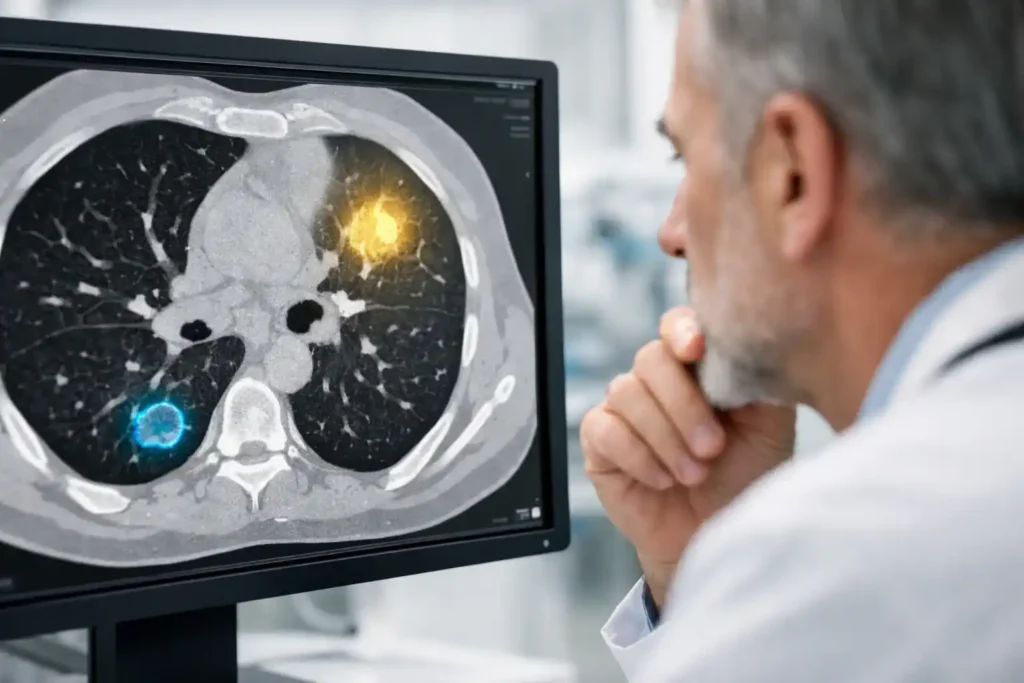
One of the most promising roles for AI medical diagnosis is catching illness before it becomes serious. Early detection is often the difference between a manageable condition and a life-threatening crisis, and that’s exactly where AI shines.
Here’s how it works in practice. AI systems can analyze medical images — scans, slides, X-rays — and identify subtle changes that might be too small or too early for the human eye to notice with confidence. They can run pattern recognition across enormous datasets, comparing your results against millions of similar cases to determine what’s normal and what isn’t. They can flag anomalies — unusual readings or unexpected findings — and bring them to a doctor’s attention before they’re buried in paperwork or missed during a long shift.
Beyond images, AI is also being used for risk prediction. By analyzing a patient’s age, medical history, lifestyle data, and lab results together, AI systems can calculate the likelihood of developing certain conditions — like heart disease or diabetes — and alert both patient and physician to act preventatively rather than reactively.
Real Examples of AI Medical Diagnosis Today
This isn’t theoretical. AI detecting disease is already happening across a wide range of medical specialties.
In cancer screening, AI tools have been shown to detect breast cancer in mammograms with impressive accuracy — sometimes catching tumors that radiologists initially missed during review. Google’s DeepMind developed an AI that can spot over 50 eye diseases from retinal scans with accuracy on par with leading specialists.
In radiology, AI doctor assistant tools now help radiologists work through high volumes of scans more efficiently. Rather than replacing the radiologist, the AI highlights areas of concern so the human expert can focus their attention where it matters most.
In cardiology, algorithms analyze heart data — from ECGs to wearable device readings — to predict risk of heart attacks and arrhythmias. Some wearable devices now incorporate these tools so that warning signs can be flagged even outside the clinic.
In pathology, AI systems analyze tissue samples under a digital microscope, identifying cancerous cells with precision that augments the work of pathologists reviewing hundreds of slides a day.
The thread running through all of these examples is the same: AI is a powerful tool that makes expert human care more effective.
Why AI Can See What Humans Sometimes Miss
Doctors are exceptional — but they are human. They work long hours, manage enormous caseloads, and process unimaginable amounts of information every single day. It’s not a failure of skill or dedication when something slips through. It’s simply the reality of being human in a demanding system.
Healthcare algorithms don’t get tired. They don’t have an off-day. They don’t lose focus after reviewing their fortieth scan of the shift. Because they’ve been trained on vast datasets — sometimes millions of medical images and patient records — they carry a kind of pattern memory that no single human could accumulate in a lifetime.
They also apply consistent analysis every single time. A tired radiologist reviewing a scan at 11 PM may not catch the same subtle detail they’d notice at 9 AM. AI doesn’t have that variability. It brings the same level of attention to every case, every time.
It’s worth saying clearly: this doesn’t mean AI is smarter than doctors. It means AI has different strengths — strengths that complement what doctors already do exceptionally well.
Does AI Replace Doctors? (Clear Answer)
No. And this point matters enough to say plainly.
AI is a tool. Doctors are the decision-makers.
No AI system currently approved for clinical use can diagnose, treat, or manage a patient independently. What these tools do is assist — they surface information, highlight findings, and support the clinical thinking of trained medical professionals.
Your doctor still examines you. They still listen to your concerns. They still apply years of medical training, clinical instinct, and human understanding to your care. The AI may help them see something they’d want to double-check, but the judgment — the decision about what to do next — remains entirely with them.
There’s also something irreplaceable about human connection in medicine. The conversation between a doctor and a patient, the reassurance, the compassion, the shared decision-making — none of that is something an algorithm can provide. Medical AI technology works best when it’s treated as a capable assistant, not a replacement for the person who actually knows and cares for you.
Benefits of AI in Healthcare for Patients
If you’re wondering what any of this means for you personally, here’s the honest answer: when AI in healthcare works well, patients benefit enormously.
Earlier detection means catching conditions when they’re most treatable — before they’ve spread, worsened, or become harder to manage. In diseases like cancer, this can be the difference between a straightforward treatment and a grueling battle.
Greater diagnostic accuracy means fewer missed diagnoses and fewer false alarms — both of which matter. A missed diagnosis delays care. An unnecessary one causes anxiety and expense.
Faster results mean less time sitting in that waiting room with your thoughts. When AI can flag a concerning finding within seconds, the whole process of getting answers can move significantly faster.
Better outcomes across the board. Studies have shown that in certain conditions, AI-supported diagnosis leads to measurable improvements in patient outcomes — more accurate staging of cancer, better identification of high-risk cardiac patients, earlier intervention in diabetic eye disease.
Concerns About AI in Medical Decisions
It would be dishonest to talk about AI in healthcare without acknowledging the legitimate concerns that come with it. No technology this significant arrives without complications.
Errors are possible. AI systems can and do make mistakes. They can miss things, flag false positives, or perform differently depending on the quality of the data they were trained on. A flagged anomaly that turns out to be nothing can cause unnecessary distress and further testing.
Bias is a real risk. If an AI is trained mostly on data from one demographic group, it may not perform as well for others. Ensuring that AI systems are trained on diverse, representative data is an ongoing challenge that researchers and developers are actively working to address.
Trust and transparency are still developing. Patients and doctors alike are right to ask: how does this system reach its conclusions? Greater transparency in how AI tools are designed and validated is something the medical field is rightly demanding.
Ethics and accountability remain open questions. If an AI assists in a decision that leads to a poor outcome, who is responsible? These questions don’t yet have fully settled answers, and ongoing dialogue between technologists, healthcare providers, regulators, and patients is essential.
None of these concerns mean AI in healthcare should be avoided. They mean it should be implemented thoughtfully, with human oversight firmly in place.
The Future of AI in the Doctor’s Office

Looking ahead, the role of AI health analysis in medicine is only going to grow — and in ways that feel genuinely exciting rather than threatening.
In the near future, we can expect smarter AI screening tools built into routine checkups, identifying risks earlier than ever before. Predictive health alerts — drawing on wearable data, genetic information, and health history — may flag concerns before a patient even notices symptoms. Clinical AI assistants may help doctors review patient notes, catch drug interactions, and surface relevant research in real time during consultations.
The goal isn’t a healthcare system run by machines. The goal is a healthcare system where doctors have better information, better tools, and more time to focus on what only they can provide — the human side of healing.
What This Means for Your Health in the Future
Here’s the part worth sitting with: the medicine of the next decade may catch things that the medicine of today would have missed. Not because doctors are getting better at being human — they already are — but because the tools supporting them are getting extraordinarily good at being machines.
If you or someone you love has ever had a diagnosis come too late, or worried that something was being overlooked, the progress being made in AI in healthcare is genuinely hopeful news. It represents thousands of researchers, clinicians, and engineers working together to make the moment in that waiting room a little less frightening — and the answer a little more certain.
Your health still depends on your doctor. It always will. But your doctor may soon have a tireless, deeply informed assistant who has seen more cases than any single human ever could — and who can quietly make sure nothing important gets missed.
That’s not a replacement for care. That’s care getting better.
The integration of AI in healthcare is advancing rapidly, and the science behind these tools continues to evolve. Always speak directly with your doctor about any health concerns and the diagnostic tools being used in your care.
