
Blockchain for Beginners: Understanding the Technology Changing How We Trust
The Notebook That Everyone Remembers
Imagine a little store on the outside of town. An old man with kind eyes runs the store and maintains a faded leather notebook behind the counter. He writes down his debts in it. “Mrs. Kumar, two kilos of rice.” Next week, I’ll pay. This notebook is trusted by everyone in the village. It’s easy. It does work. It has been working for twenty years.
But one morning, things change.
A page gets ripped. Someone says they paid off their obligation, but the record is gone. The numbers change. There are problems with stories. Nobody knows what the truth is anymore. The shopkeeper is honest, but the notebook, which is the only source of truth, has broken. Trust breaks down, not because someone lied, but because the system relied on one weak record.
Stop for a second now.
Think of a different kind of notebook. One that no one can modify without telling anyone. One that everyone in the hamlet can see at once. If someone tries to remove a line, a thousand other copies will disagree right away. Not locks or guards, but the memory of everyone keeps the truth safe.
That weird, almost mystical thought? That’s what blockchain technology is all about emotionally.
Why the Internet Has a Trust Problem
Think about how we use the internet now. Someone else has to handle every transaction, message, and record. A bank moves your money when you send it. A payment app checks that you bought anything online. A platform saves a document when you share it.
We have constructed the whole digital world on middlemen.
We trust these systems because someone is in charge of them. A business. A government. A place of business. They keep the files. They check to see if it’s true. They say, “Yes, this happened,” and we believe them because we have no other choice.
But what happens if the middleman makes a mistake? Or makes new rules? Or does it go away completely?
The internet is still like that village shop notepad, with all its power: records are kept in one place and controlled by one person. Blockchain is seeking to answer a wider question: “Can we build trust without having to have someone in the middle?
The Blockchain Idea: A Shared Memory
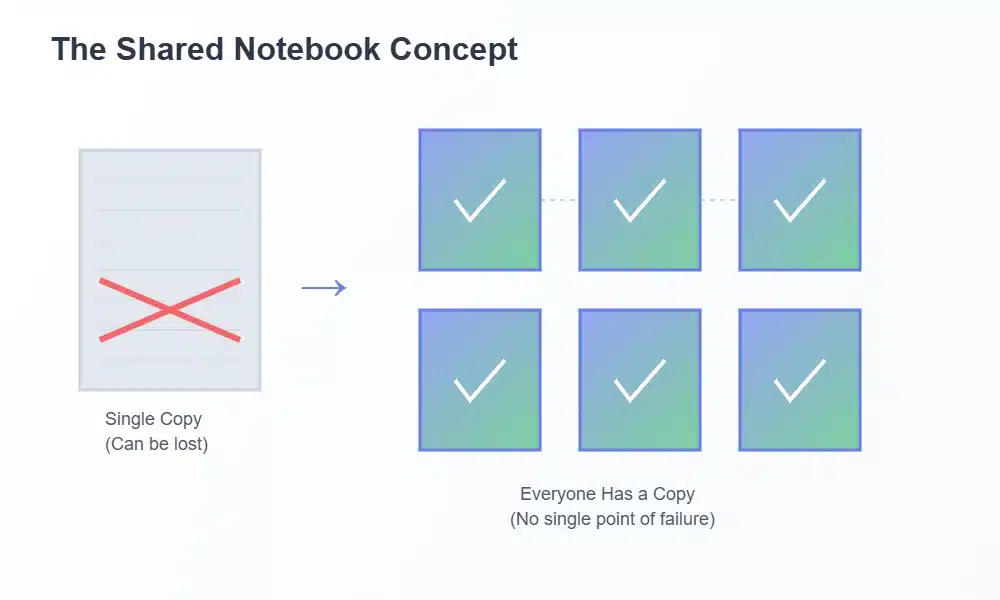
In simple terms, blockchain is a shared record that everyone has a copy of and no one person owns.
Imagine a notepad that thousands of people have copies of. Everyone’s copy updates at the same time when something new is written, such a deal, a transaction, or a piece of data. The other people will know right away if someone tries to update their version. The majority decides what is true.
This is what sets blockchain apart from regular databases. A normal database is stored on the server of a business. One system. One person in charge. Blockchain makes a distributed ledger by spreading the record over a network of computers.
No one person is in charge. No one person in charge. Just checking together.
How Blockchain Works: Chains and Blocks
You can tell what a blockchain is by its name. Think of the pages in that village notebook, but on a computer. Each page is called a “block,” and it has a lot of information on it, like transactions, records, and data.
The smart aspect is that each block is sealed to the one before it, just like how every page in a book refers to the one before it. This makes a “chain” of blocks that goes back in time. Everyone will see the break if you take away a chapter from the middle.
When a new block is added, it is secured in place using complicated arithmetic (this is known as cryptography, but you don’t need to know the math to comprehend the idea). Changing the block after it was sealed would mean altering every block that came after it on thousands of computers all at once.
It’s like trying to change the past when everyone remembers it exactly.
Why Blockchain Can’t Be Easily Changed
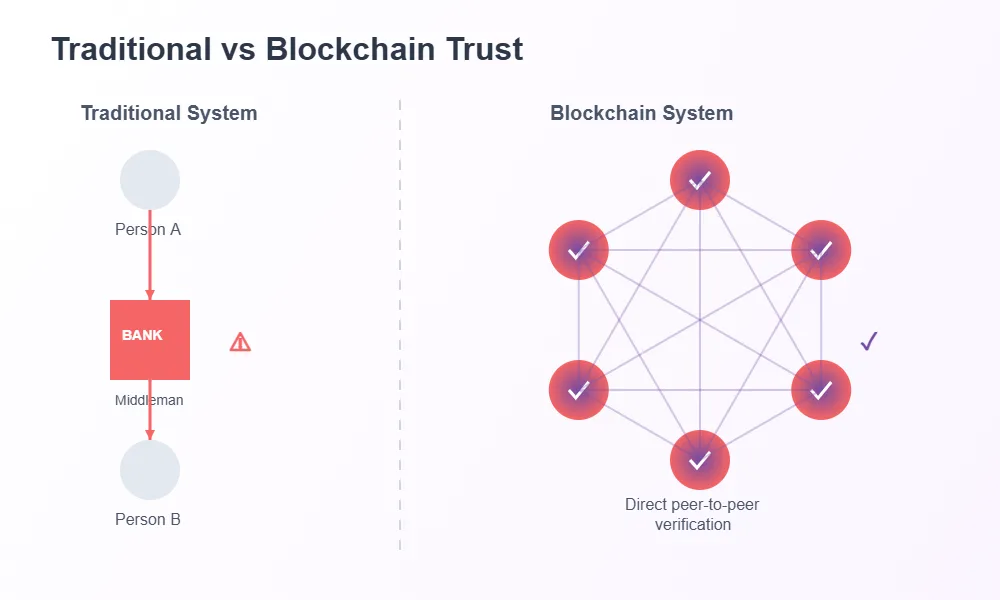
This is what makes blockchain technology so powerful. If I have one copy of a record and you have another, and ten thousand other people have theirs, we can always compare. The network won’t accept my version if it says one thing and everyone else’s says something else.
It’s like a Google doc history that everyone can see but no one can change without telling everyone else. Or a public scoreboard that everyone can see and that updates in real time. Any attempt to cheat is immediately clear.
This makes something that is quite unusual in the digital world: immutability. Not because the data is locked up, but because lies can’t hide when so many people see them.
Real-Life Comparisons That Make Sense
Here are some examples from everyday life that show what blockchain does:
The class attendance sheet: Picture a classroom where each student keeps track of their own attendance. They compare at the end of the day. If one kid says they were there but everyone else’s record says they weren’t, it’s evident what happened.
The shared game scoreboard: Imagine a sports game where the score isn’t recorded by one referee, but is shown on a thousand displays at simultaneously. The other screens will indicate the lie right away if someone tries to modify the score on one of them.
The public village announcement: In certain cultures, big deals are made public in the town square so that everyone may see them. The community remembers, so no one can say it didn’t happen later.
Digital witnessing is what blockchain is. Proof from many people. Truth that is shared.
What Blockchain Actually Enables
So, what does this technology do in the actual world? Let’s get past the abstract.
The most well-known example is cryptocurrency. Blockchain lets Bitcoin, Ethereum, and other cryptocurrencies keep track of who owns what without a bank. There is a public record of every coin movement. The money is not printed or controlled by a central authority. It shows that you own something without having to ask an institution for permission.
But blockchain is more than just digital money.
You can follow a product from the production to the retailer via “supply chain tracking.” If you could scan a coffee bag and see every step it took, like the farm where it grew, the ship that brought it, and the warehouse where it was stored. No organization can falsify the journey because everyone can see the record.
Digital identification could help you prove who you are without having to give every website all of your documents. You are in charge of your identity; other people only check it against the blockchain.
Blockchain might store ownership records for items like concert tickets, property, or art. The ledger indicates you own it, not the company’s database.
The pattern? Blockchain lets you prove something without needing permission. Checking without having to wait for clearance. Have faith without a middleman getting in the way.
What Blockchain Is NOT
Let’s be honest and clear up some of the confusion that has come up about blockchain.
Blockchain isn’t just for cryptocurrencies. Bitcoin came up with the idea, but the technology is more than just money. If you only think about crypto, you miss the bigger idea.
It’s not magic money that makes people affluent. A lot of people lost money when they speculated on crypto. Blockchain is not a way to get rich quickly; it is a tool. It can be used well or poorly, just like any other technology.
It’s not complete chaos without names. Most blockchains are actually more open than regular systems because everyone can see every transaction (even if the people involved are using fake names). It’s not a free-for-all; it’s a different kind of order.
It’s not the answer to everything. Some issues really do need a reliable go-between. Not every issue needs to be decentralised. Blockchain is most useful when many people need to trust a shared record but not each other totally.
Stay grounded. Blockchain is strong, but it can’t take the place of all the mechanisms that are already in place.
The Future We’re Building Toward
For a moment, close your eyes and picture a new kind of internet.
One where you own your medical records and only share them when you want to. Any doctor can check them without phoning your old clinic. One where artists get paid directly when their work is used, and the payments are tracked automatically through clear records. One where everyone can check the voting mechanisms, which makes fraud almost impossible.
This isn’t a dream; it’s the quiet hope behind blockchain development.
It doesn’t point to a future where everything we know is replaced. It’s about making other options. Clear records where earlier there was no way to see the truth. Get rid of middlemen and keep your ownership safe. Fair digital systems where power was kept in one place.
Is this really how it will happen? Not likely. Things don’t always go as planned with technology. But the path is clear: more distributed trust, less reliance on a few gatekeepers, and more control over one’s digital life.
Why This Is More Important Than You Think
In today’s environment, trust costs a lot. We give banks our money and they charge us fees. We provide our data to platforms, and they sell it. We give companies our records, and sometimes they lose them.
Blockchain poses a straightforward yet important inquiry: What if we were not obligated to?
What if the system itself could build trust by being open and letting everyone check things? What if we could show things without asking for permission? What if the internet could recall the truth in a way that no one power could change?
This is why a good explanation of blockchain doesn’t actually talk about technical specifics or the pricing of cryptocurrencies. It’s about changing how we think about truth, memory, and trust in the digital age.
The Final Truth
The most important thing to remember is that blockchain isn’t about money first. It’s about memory that no one can change without making noise.
It’s about making digital systems where the record speaks for itself, where thousands of people keep an eye on things, and where it becomes almost impossible to change the past because the present remembers so well.
Remember that store in the village? The page of the notepad that was ripped. The trust that was broken.
Now picture a world where the notebook never tears, never fades, and everyone has a copy. Where a group of people protects the truth instead of an authority.
That’s not just blockchain technology; it’s a new approach to think about what trust could look like when we construct systems that remember things together.
The internet is getting better at trusting people without having to go through middlemen. The question is whether we are ready for what that means.
*To comprehend blockchain, you need to know how technology can build trust via openness, verification through community, and memory through shared witnessing. It isn’t perfect or magical, but it could be one of the most interesting concepts about how people can work together in a digital world.
