
Quantum Computing Explained: How Future Computers See Possibilities
Picture this: A student is sitting at a desk late at night with a pencil in hand, staring at a hard maze on paper. They draw a line with their finger and hit a wall. They attempt a new technique, but it’s still not allowed. Try again. Another failure. We tested each alternative one at a time, slowly and cautiously.
Now think of something strange.
What if you could do all the paths at the same time? What if you didn’t have to choose one way or the other, but could somehow see both at the same time?
Think about that for a second.
Quantum computers think that strange, nearly impossible thought.
The Quiet Limits of Normal Computers
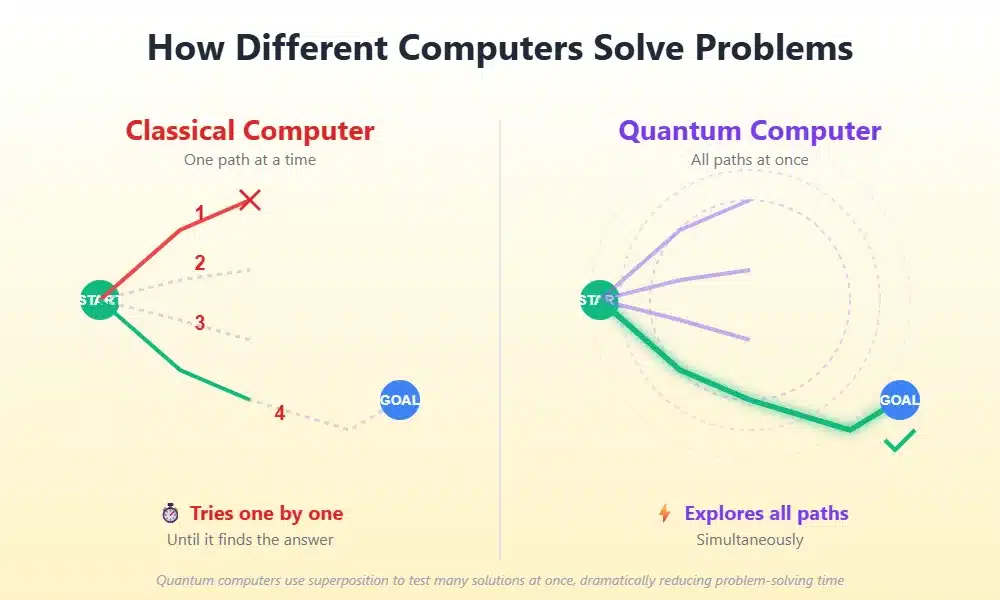
Let’s begin with what we already know. Your laptop, phone, or tablet is like the student in the maze right now. It tries something, then something else, and then something else. One step at a time. One road at a time.
It’s like trying different keys in a lock. You try out the first key. Not working. You should attempt the second one. Still locked. Three, four, five—until one finally works. This is how computers that have been around for a long time work. It’s planned. It works. But it’s also not very good.
Bits are tiny switches that your computer utilises to work with data. There could be one (1) or zero (0) of them. These brief yes-or-no decisions make up every calculation, every movie you watch, and every letter you type.
A regular computer looks at each choice one at a time. And for most of the things we do, including playing games, editing photos, and surfing the web, this works well. But this is where things become interesting.
The Quantum Idea: A Different Way of Seeing
Quantum computing does more than just speed things up. It thinks in a different way.
Imagine going back to the maze, but this time something great happens. You don’t only go down one path at a time; you seem to be in all parts of the maze at the same time. You can see all the hallways, corners, and options at once.
It sounds like something out of a fairy tale. This is the most important thing that quantum computers can do.
A classical computer tries one response, then another, and so on. A quantum computer, on the other hand, can examine at many pathways at once. It doesn’t choose one option; instead, it remembers all of them until it finds the right one.
You don’t have to remember the word “superposition,” yet that’s where this strange skill comes from. The important thing is the idea: being in more than one condition at once.
The Spinning Coin: A Simple Way to Understand Bits and Qubits
To make this even evident, let’s utilise something you can see.
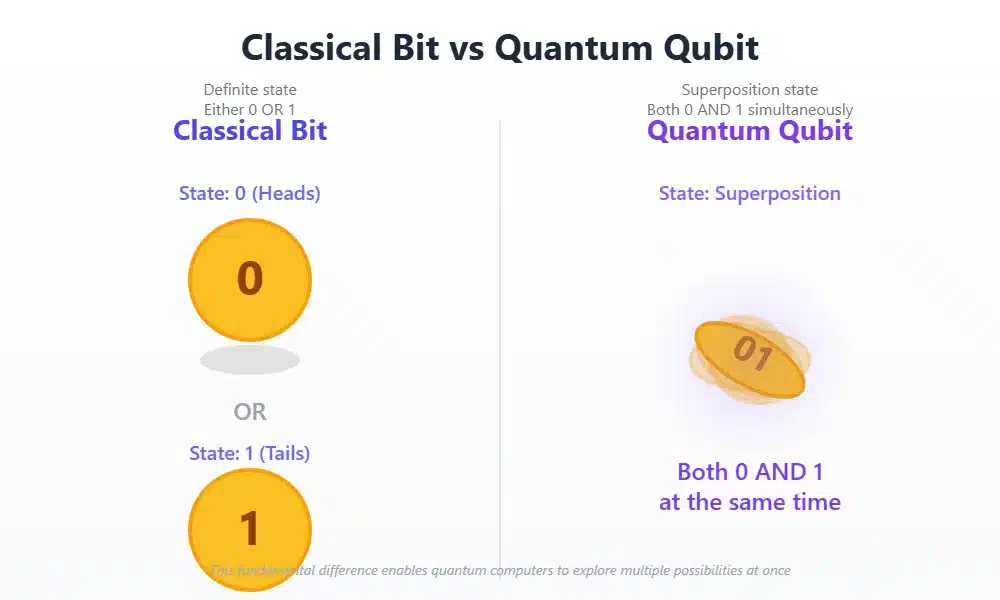
Put a regular coin on the table. What do you see? Heads or tails. This or that is all there is. It’s like a classical bit that can only be 0 or 1. Simple. Got it. Definitely.
Now imagine that coin spinning in the air. When it’s whirling, is it heads or tails? It’s both. It’s not one or the other. It’s in the middle of the two. A lot of things might happen.
That spinning coin is like a qubit, which is a quantum bit.
A qubit can be something other than 0 or 1. It can be both at the same time. And when you have a lot of qubits working together, they can do a lot of different things. Four items can be shown at the same time by two qubits. Three qubits can make eight different things happen. Ten qubits? Over a thousand choices were looked at at once.
Quantum computing gains its power not from speed, but from the fact that it can look at many choices at once.
Why This Changes Everything: Problems That Are Real and Have Real Effects
You could be thinking, “Okay, but what’s the point?” Why do we need machines that can accomplish this?
This is the deal. Some problems in our environment are just too enormous for normal computers to solve. Not because they’re slow, but because there are so many choices.
Think about what it would be like if scientists were looking for a new medicine. They need to know how a molecule will move and change shape as it interacts with other molecules in your body. How many different ways can you put them together? Tonnes and tonnes.
It could take a regular computer thousands of years to look at every alternative. A quantum computer could get the answer in a few hours or days since it can look at many choices at once.
Or how about making a model of the weather? The weather on Earth is affected by several things, such as temperature, wind, ocean currents, and cloud patterns. All of these things function together in a sophisticated way. Quantum computers could simulate these interactions with unmatched accuracy, perhaps enhancing our comprehension of climatic variations and enabling us to predict them.
Materials science is another field of study. Consider discovering novel battery materials that could sustain automotive operation for weeks rather than hours. Or producing superconductors that work at room temperature, which would transform how energy is provided.
And then there’s the part about encrypting. Quantum computers might be able to break the codes that keep your messages private, your bank account protected, and your data safe in ways that classical computers can’t. But they might also come up with new codes that can’t be broken. It’s both a chance and a fight.
These aren’t made-up stories. These are the kinds of challenges that normal computers can’t handle. To fix them, you need to think about a variety of different things. This is where quantum computing really shines.
Using examples from real life to make the abstract real
It’s easier to understand something strange when you compare it to something you already know.
You could want to look for a specific sentence in a big book. A normal computer would read page one, then page two, and so on, line by line, word by word, until it located what you were looking for. It would be like being able to feel the whole book at once and knowing exactly where that sentence is.
Or think about this: you’re trying to decide what to wear. You have five shirts and four pairs of trousers. When you employ a classical method, you test one combination, look in the mirror, make a choice, and then try another. A quantum approach would be like being able to see all twenty possible versions of yourself at once and deciding which one looks best right away.
It’s like thinking in a line or thinking in a circle. A bunch of doors opening at once instead of opening each one one at a time.
What Quantum Computers Are NOT (Let’s Get Real)
This is when we need to stop and think about what we want.
There is no magic in quantum computers that will make them replace your laptop tomorrow. They aren’t just faster versions of regular computers. For most activities, like composing emails, streaming videos, and playing games, classical PCs are preferable.
A quantum computer is like a particular tool, just how a telescope is good for viewing stars far away but not so good for reading a book. Quantum computers are great at tackling some problems, such those that have a lot of viable answers at once. But they aren’t computers that can be used for anything.
They are also incredibly weak. Qubits aren’t extremely strong. They need to be kept at temperatures lower than those in space. Even the tiniest vibrations, electromagnetic interference, and stray photons can affect them a lot. Building and keeping them up takes a lot of skill.
And this is just the start of our trip. Quantum computers are like the first aeroplanes: they’re great for what they are, but they’re not ready to replace cars for your daily commute yet.
So, no, you won’t be able to have a quantum phone very soon. But it doesn’t mean they’re not groundbreaking.
The Future Feeling: A World That Has Changed
Take a second to close your eyes and contemplate.
A place where doctors enter the molecular structure of a disease into a quantum computer and get plans for viable treatments in days instead of decades.
Factories utilise quantum simulations to create new materials, such batteries that charge in minutes and last for weeks, or fabrics that change automatically to meet the temperature.
Cities that use quantum algorithms to make traffic go more smoothly in real time, which reduces both emissions and trip time.
Financial systems that can employ models of the economy that are too intricate to forecast how the market will move.
Forecasts that are accurate weeks ahead of time instead of just days, so that towns can be ready for bad storms.
This isn’t a story that will happen in the future. These are the things that quantum computing makes possible in the actual world. The technology is still young and evolving, and there are still a lot of things we don’t know about it. But the possibility is evident.
This moment is quite interesting because it’s the start. We can see some of the locations this might take us, but not all of them yet.
The Amazingness of Different Ways of Thinking
There is something deeper going on here than just the technical facts.
For decades, we’ve been employing the same basic principle of step-by-step calculation to make computers faster, chips cheaper, and processors more powerful. We are pretty good at it now. But we’ve also been trying to solve other problems in the same way: by being quick and determined.
Quantum computing poses an alternative inquiry: What if we do not exert greater effort? What if we try something else?
It reminds us that sometimes the best way to solve an issue isn’t to do the same thing faster, but to look at it from a completely new angle.
The student with the maze didn’t need a pencil that wrote faster or sharper eyes. They had to come up with a completely different plan to get through the problem. Not going down paths one at a time, but being in the maze itself and seeing all the choices at once.
That’s what “shift” implies in the world of quantum computing. Faster maths and other ways of thinking, too.
A Final Thought
Look up at the sky on a clear night. The light you see has been on its way to your eyes for millions of years. The cosmos has rules that can appear strange, contradictory, and even magical at times.
Quantum computing operates on the same fundamental principles that govern reality at its most minute levels. For instance, particles can be in two places at once, what you see affects what happens, and things that seem impossible become less likely.
We are exploiting the weird rules of quantum mechanics to help folks who are having trouble. We’re changing the language of atoms into the language of computers.
Quantum computers don’t just do math faster; they also see things in a different way. They find answers in ways that our old technologies can’t. They remind us that the universe still has a lot to teach us and that new ideas often come from accepting things that seem impossible at first.
The future of computers isn’t just about how fast they are. The way you look at things is everything. It’s about learning to think like the universe itself: holding several truths at once, looking at multiple paths, and finding answers in the space between what is known.
And what about the future? It has already begun.
The quantum revolution is here, and it’s changing the way we think about problems and use computers in big ways. And sometimes, the most powerful computation of all is the shift in how you think.
